



This post was published by Jon Fleetwood. Support him by subscribing at Substack and following at Instagram / X / Facebook.

For decades, U.S. taxpayer-funded coronavirologist Ralph Baric developed increasingly sophisticated methods for reconstructing, modifying, and engineering coronaviruses.
Before 2019, his work claimed to explain down to the molecular level how to build coronaviruses with the defining properties (here) of the purported COVID-19 pandemic virus, SARS-CoV-2 (having six segments separated by five restriction sites and a spike protein with optimized furin cleavage sites, receptor-binding domains, and two-proline vaccine constructs).
But Baric’s work depended on an earlier generation of coronavirus research.
Before coronavirus could be said to be cloned, manipulated, or engineered, researchers first had to establish what coronavirus was understood to be at the molecular level.
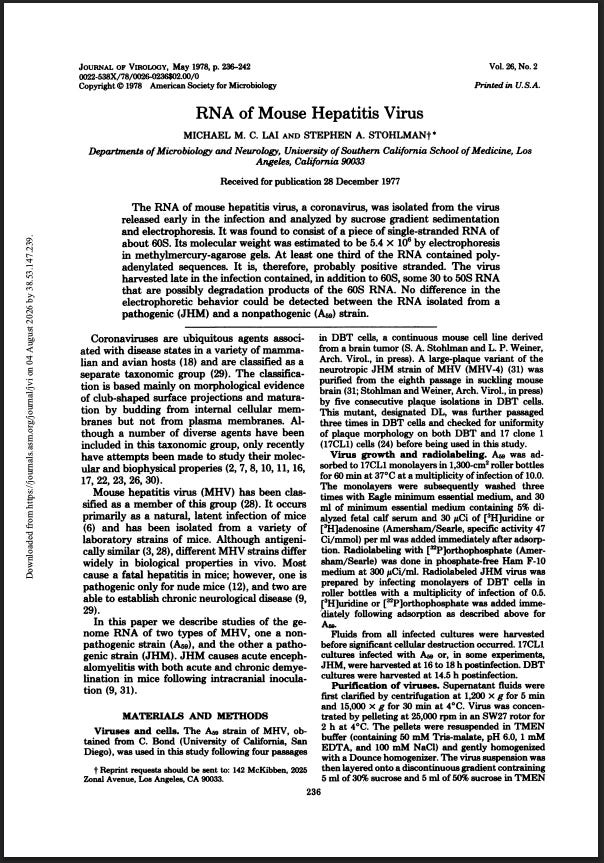
One of the earliest papers attempting to answer that question was Michael M. C. Lai’s 1978 paper, RNA of Mouse Hepatitis Virus, funded by the U.S. government under grants 1F32-NS-05410 and RO1-NS-12967.
Rather than directly observing what it ultimately described as the coronavirus genome, the paper used a series of laboratory measurements to infer conclusions about coronavirus’s molecular and genetic properties.
That’s important because Baric spent much of the early 1980s co-authoring coronavirus molecular genetics papers with Lai, helping develop the molecular framework that Baric’s later engineering work would build upon.
If the molecular and genetic properties of coronavirus were originally established through interpretation of laboratory measurements rather than direct observation, how many later conclusions about the coronavirus genome ultimately rest on inherited inferences rather than direct observation?
The Paper Began With Laboratory Measurements
According to the paper, the researchers collected biological material from treated cell cultures.
They then separated portions of that material through repeated centrifugation, chemically processed selected portions, and subjected the recovered material to multiple laboratory tests.
Those procedures produced measurements.
Not genes.
Not genomes.
Measurements.
Among them were:

- sedimentation behavior during centrifugation,
- migration patterns during electrophoresis,
- sensitivity to RNase,
- and binding in a poly(A) assay.
The instruments produced peaks, bands, enzyme reactions, and binding results.
They did not directly observe what the paper ultimately described as coronavirus genetic material.
The Paper Then Attributed Genetic Properties to Coronavirus
After presenting those laboratory measurements, the paper drew broader conclusions.
The authors concluded that coronavirus possessed:
- one large RNA molecule,
- a particular estimated molecular weight,
- a single-stranded structure,
- was “probably” positive stranded,
- and possessed the genetic coding capacity discussed throughout the paper.
Those statements are not instrument outputs.
They are the paper’s interpretation of the laboratory measurements.
In other words, the paper moved from measured laboratory behavior to published statements describing the proposed genetic properties of coronavirus.
What Else Could the Measurements Mean?
One of the most important distinctions in Lai’s paper is the difference between what the laboratory instruments directly measured and what the paper concluded those measurements meant.
The laboratory measurements did not logically require the conclusion that the recovered RNA was the coronavirus genome.
They required an additional interpretive step that attributed those measured properties to coronavirus itself.
The instruments themselves did not report:
- “coronavirus,”
- “genome,”
- “single stranded,”
- or “positive stranded.”
Instead, they produced physical laboratory observations.
- A centrifuge measured how material sedimented.
- A gel measured how recovered material migrated.
- RNase testing measured whether the recovered material was sensitive to enzymatic degradation.
- A poly(A) assay measured binding behavior.
Those observations are physical measurements.
The biological meaning of those measurements had to be inferred.
For example, a single band on a gel establishes only that a recovered material migrated as one dominant band under those experimental conditions.
- By itself, it does not establish what that material is.
Likewise, RNase sensitivity establishes only that the recovered material behaves as RNase-sensitive nucleic acid under the conditions of the assay.
- It does not, by itself, establish its biological origin.
Sedimentation behavior establishes that material sediments in a particular way.
- It does not uniquely identify the molecular identity of that material.
Poly(A) binding establishes that material interacted with the assay.
- It does not, by itself, establish that the material is a coronavirus genome or determine its strand polarity.
The paper therefore combined all of those laboratory observations and interpreted them together as evidence that coronavirus possessed a single large RNA genome with specific genetic properties.
That interpretation became the paper’s conclusion.
The measurements themselves, however, do not contain biological labels.
They describe how recovered material behaved under laboratory conditions.
The paper supplied what those behaviors meant.
Later coronavirus researchers generally inherited those published interpretations as part of the molecular framework of the discipline rather than re-establishing them from first principles.
A Molecular Framework For Later Coronavirology
The importance of Lai’s paper lies not only in its inferred conclusions.
It lies in what later coronavirus researchers like Baric did with them.
Subsequent coronavirus papers generally did not begin by re-establishing whether coronavirus possessed these proposed molecular properties.
Instead, researchers increasingly treated those conclusions as established and turned to new questions:
- How are coronavirus genes organized?
- How are they transcribed?
- How does recombination occur?
- How can coronavirus genomes be reconstructed?
- How can they be experimentally manipulated?
Over the following decades, coronavirus research shifted from characterizing coronavirus’s proposed genetic properties to studying, modifying, and ultimately engineering them.
Before Engineering Came Attribution
Ralph Baric’s laboratory did not begin by determining whether coronavirus possessed a genome with particular molecular characteristics.
His work largely assumed the molecular framework established by earlier coronavirus research.
That earlier work, including Lai’s, attempted to announce what genetic properties coronavirus possessed by interpreting laboratory measurements and publishing those interpretation-dependent conclusions as characteristics of coronavirus itself.
Only after those proposed properties became accepted within the discipline could later researchers begin organizing them, manipulating them, and eventually engineering them.
Bottom Line
Michael M. C. Lai’s 1978 paper marks an early turning point in the development of molecular coronavirology.
Rather than directly observing what it ultimately described as the coronavirus genome, the paper interpreted a series of laboratory measurements and published conclusions attributing specific molecular and genetic properties to coronavirus itself.
Over the decades that followed, later coronavirus researchers generally inherited those published interpretations rather than re-establishing them from first principles.
As the field progressed from molecular characterization to transcription, recombination, reverse genetics, infectious clones, and ultimately coronavirus engineering, the interpretive framework established by early papers like Lai’s became part of the discipline’s accepted foundation.
The broader question is not whether Lai’s conclusions were correct or incorrect.
It is how much of modern molecular coronavirology—including later claims about the coronavirus genome and COVID-19 origins—rests on direct observation, and how much rests on interpretations that became accepted as foundational over time.
Your support is crucial in helping us defeat mass censorship. Please consider donating via Locals or check out our unique merch. Follow us on X @ModernityNews.
More news on our radar
Scientists are under pressure to turn a guess into a fact to secure funding. The same can be said for many measurements or observations within a particular field. As an example our current procedure to test and treat high colesteral is based on one study done in 1964. It has been chalenged many time without any change within the scientific community.