



This post was published by Jon Fleetwood. Support him by subscribing at Substack and following at Instagram / X / Facebook.

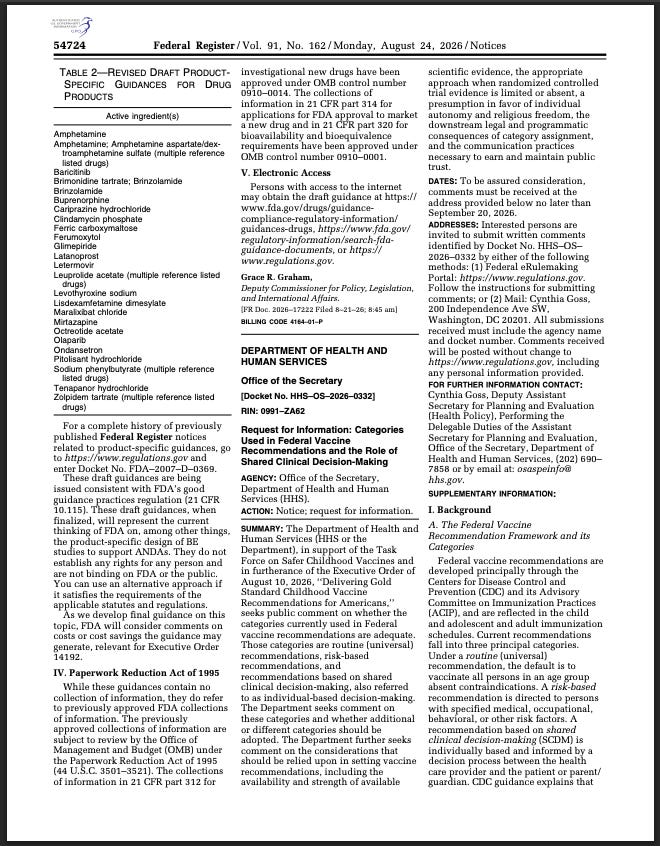
The Department of Health and Human Services (HHS) is seeking public comment on whether federal vaccine recommendations should operate with “a presumption in favor of individual autonomy, informed consent, and religious freedom,” as the agency reconsiders the framework used to recommend vaccines nationwide.
You can submit a comment here.
The request appears in a Monday Federal Register notice signed by HHS Secretary Robert F. Kennedy Jr. and issued in support of the Task Force on Safer Childhood Vaccines and President Donald Trump’s Aug. 10 executive order on childhood vaccine recommendations.
HHS says it is reconsidering the three categories currently used by the federal government: routine, or “universal,” recommendations; risk-based recommendations; and shared or individual clinical decision-making.
The agency states:
“The Department seeks comment on these categories and whether additional or different categories should be adopted. The Department further seeks comment on the considerations that should be relied upon in setting vaccine recommendations, including the availability and strength of available scientific evidence, the appropriate approach when randomized controlled trial evidence is limited or absent, a presumption in favor of individual autonomy and religious freedom, the downstream legal and programmatic consequences of category assignment, and the communication practices necessary to earn and maintain public trust.”
Under the existing system, HHS says a routine recommendation carries an explicit default:
“Under a routine (universal) recommendation, the default is to vaccinate all persons in an age group absent contraindications.”
By comparison, CDC guidance says that under shared clinical decision-making, “there is no default.”
Public comments are due September 20.
Interested persons are also given the following instructions:
“Interested persons are invited to submit written comments identified by Docket No. HHS-OS-2026-0332 by either of the following methods: (1) Federal eRulemaking Portal: https://www.regulations.gov. Follow the instructions for submitting comments; or (2) Mail: Cynthia Goss, 200 Independence Ave SW, Washington, DC 20201. All submissions received must include the agency name and docket number. Comments received will be posted without change to https://www.regulations.gov, including any personal information provided.”
For further information, requesters are asked to contact:
“Cynthia Goss, Deputy Assistant Secretary for Planning and Evaluation (Health Policy), Performing the Delegable Duties of the Assistant Secretary for Planning and Evaluation, Office of the Secretary, Department of Health and Human Services, (202) 690-7858 or by email at: osaspeinfo@hhs.gov.”
‘Recommended, But Not During Infancy’
HHS is now asking whether additional categories should replace or supplement that framework—including one explicitly addressing infant vaccination:

“Should additional or different categories be adopted, such as ‘recommended, but not during infancy’ (or otherwise age-de-emphasized recommendations); ‘recommended with qualification’; or ‘shared clinical decision-making with qualification’?”
The agency is also asking whether the schedule should provide greater flexibility for vaccine timing and for “administering vaccines individually versus at a single visit.”
‘Presumption’ for Autonomy, Informed Consent, & Religious Freedom
One of the notice’s most consequential questions concerns what principles should govern federal vaccine recommendations in the first place.
HHS asks:
“What considerations should be relied upon in establishing vaccine recommendations and assigning categories, and under what conditions should each predominate? Commenters are specifically invited to address the availability, quality, and strength of evidence; the appropriate approach where randomized controlled trial evidence is absent, infeasible, or unethical to obtain; disease severity and epidemiology; individual versus population benefit; a presumption in favor of individual autonomy, informed consent, and religious freedom; and feasibility and programmatic consequences.”
HHS immediately follows that question by asking whether uncertainty surrounding vaccine evidence has been effectively hidden inside the recommendation itself:
“When evidence is limited, uncertain, or evolving, how should that uncertainty be reflected in the recommendation itself, whether through category assignment, qualifying language, sunset or re-review provisions, or explicit statements of evidentiary certainty, rather than resolved silently in favor of either a universal recommendation or no recommendation?”
HHS Points to COVID-Era Vaccine Policy
HHS explicitly invokes COVID-19 while explaining why the federal recommendation framework is being reconsidered.
The department says federal COVID vaccine policy “shifted toward progressively broader, population-wide recommendations,” despite criticism over the evidence supporting some of those decisions.
It also recounts the CDC director’s 2021 decision to override an ACIP vote against recommending boosters to certain adults based on occupational or institutional exposure.
HHS writes:
“In the Department’s view, episodes in which the deliberative advisory process reaches a narrower conclusion that is then overridden in favor of a broader, top-down recommendation contribute to public doubt about whether Federal recommendations in fact reflect the process created to produce them, and thereby to mistrust of the system as a whole.”
The department then turns directly to the legacy of COVID-era recommendations:
“The Department’s working premise is that recommendations perceived as premature, overconfident, or insulated from candor about uncertainty, as many Americans perceived certain COVID–19-era recommendations to be, impose lasting costs on the credibility of all Federal vaccine recommendations, including those resting on the strongest evidence.”
HHS separately says a “substantial body of research” indicates that “top-down mandates and coercive measures can sow distrust and provoke psychological reactance,” while acknowledging that other research found mandates increased vaccine uptake.
Bottom Line
HHS has not yet changed federal vaccine recommendations.
The department explicitly says the notice “does not constitute a rule, a proposed rule, or a recommendation,” and does not alter existing vaccine recommendations or coverage requirements.
But the questions now officially before HHS are unusually fundamental:
- whether universal vaccination should remain the default,
- whether some vaccines should be “recommended, but not during infancy,”
- what should happen when randomized controlled trial evidence is absent,
- whether uncertain evidence has been “resolved silently,”
- and whether federal vaccine policy should begin with “a presumption in favor of individual autonomy, informed consent, and religious freedom.”
Interested individuals can submit a comment here.
Your support is crucial in helping us defeat mass censorship. Please consider donating via Locals or check out our unique merch. Follow us on X @ModernityNews.
More news on our radar