



This post was published by Jon Fleetwood. Support him by subscribing at Substack and following at Instagram / X / Facebook.

BioNTech has terminated a Phase 2 trial of its experimental mRNA cancer shot autogene cevumeran (BNT122) after an independent monitoring board found an imbalance in overall survival, with development partner Genentech confirming there were “more deaths in the vaccine arm.”
BioNTech co-developed the Pfizer-BioNTech COVID-19 mRNA vaccine sold as Comirnaty.
The cancer jab termination came about 10 months after the trial had already crossed a prespecified futility boundary but was allowed to continue.
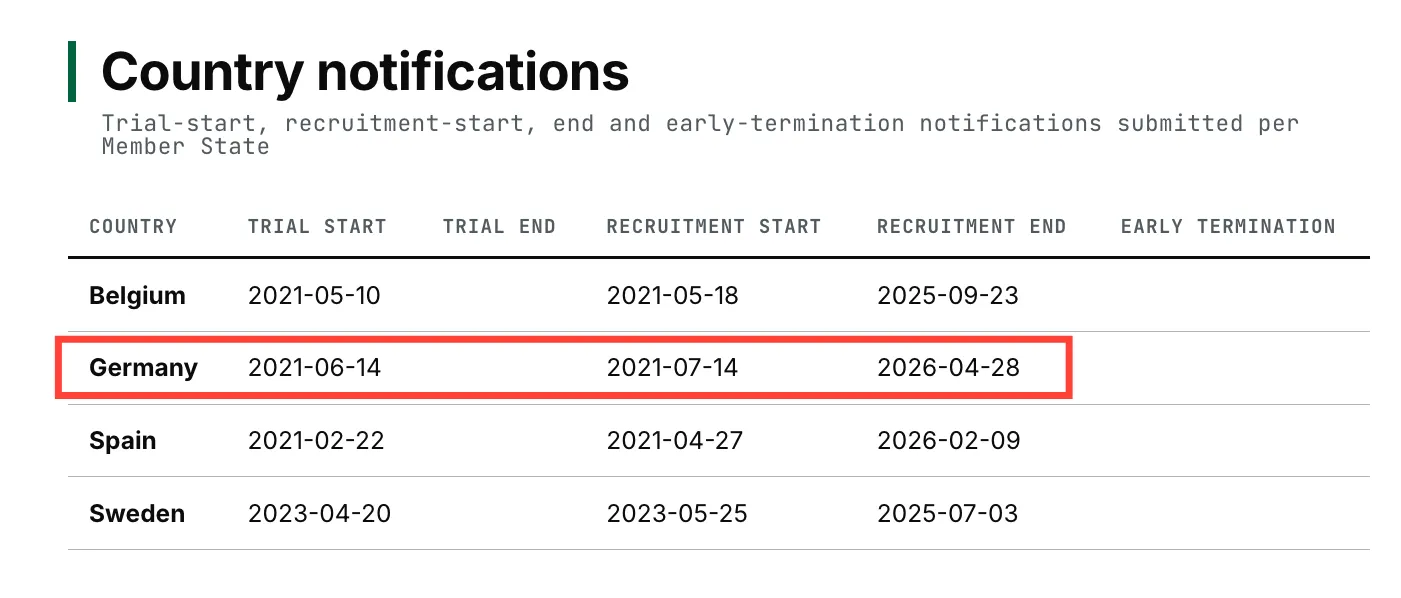
Public European trial records show that new patients continued to be recruited for roughly six months after the futility boundary was crossed, with recruitment continuing in Germany until April 28, 2026.
BioNTech has not publicly disclosed how many people died in either group.
‘More Deaths in the Vaccine Arm’
BioNTech announced August 28 that it was terminating BNT122-01, its randomized Phase 2 trial of autogene cevumeran, also known as BNT122 or RO7198457.
The company said the independent Data Safety Monitoring Board (DSMB) had reviewed the trial data and:
“identified a numerical imbalance in overall survival between treatment arms.”
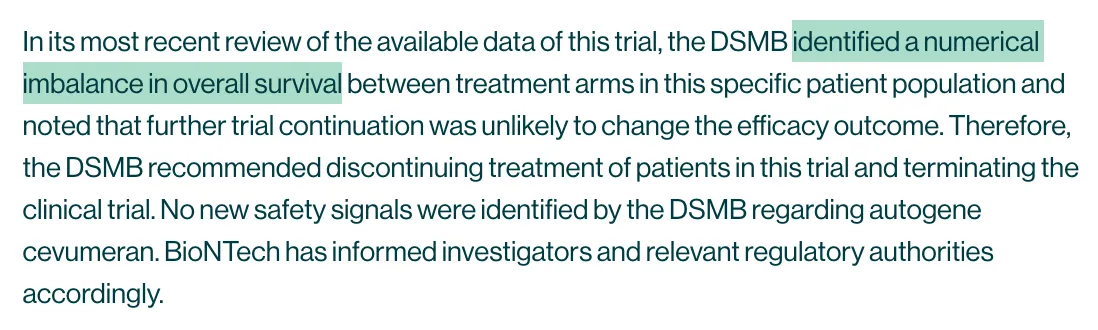
The board also determined that continuing the trial was unlikely to change the efficacy outcome and recommended stopping treatment and terminating the study.
BioNTech did not say which arm had more deaths.

Genentech did.
Asked by Fierce Biotech, a Genentech spokesperson confirmed there were:
“more deaths in the vaccine arm in this specific patient population.”
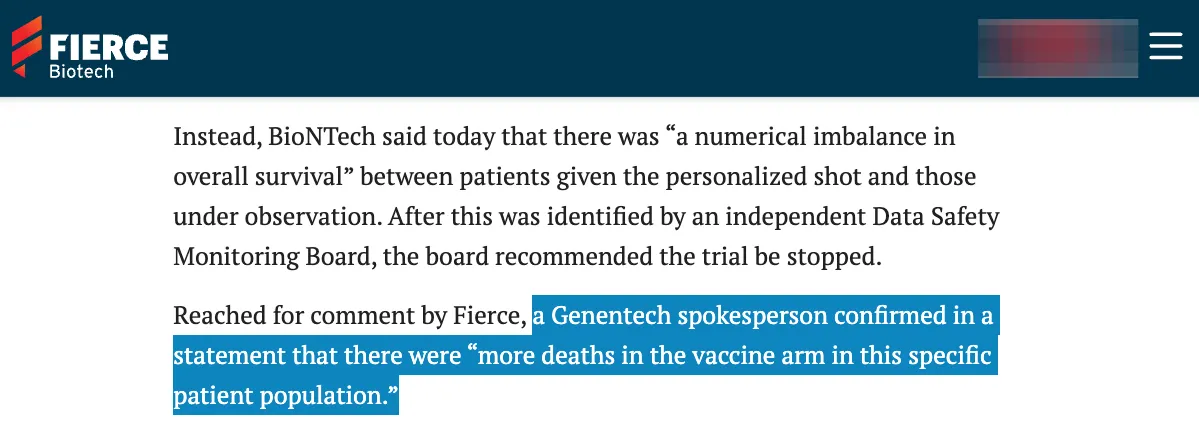
The companies have not disclosed the number of deaths in either arm or the magnitude of the survival difference.
The Comparison Group Received No Experimental Treatment
The BioNTech-supplied ClinicalTrials.gov record says the trial was randomized and used parallel assignment.
Patients in the experimental arm received RO7198457 intravenously.
The comparison group underwent watchful waiting, which the registry explicitly describes as:
“Observational group (no intervention)”
BioNTech’s own announcement likewise says the trial compared the experimental mRNA treatment with watchful waiting.
The registry defines the trial’s overall-survival endpoint simply as:
“time from randomization to death from any cause.”
So the finding is straightforward: more deaths occurred among patients randomized to receive the experimental mRNA treatment than among those assigned to watchful waiting.
What remains unknown is why.
BioNTech Continued the Trial After It Crossed Its Futility Boundary
The August announcement also confirms that this was not the trial’s first major warning.
According to BioNTech:
“the futility boundary was crossed in October 2025.”
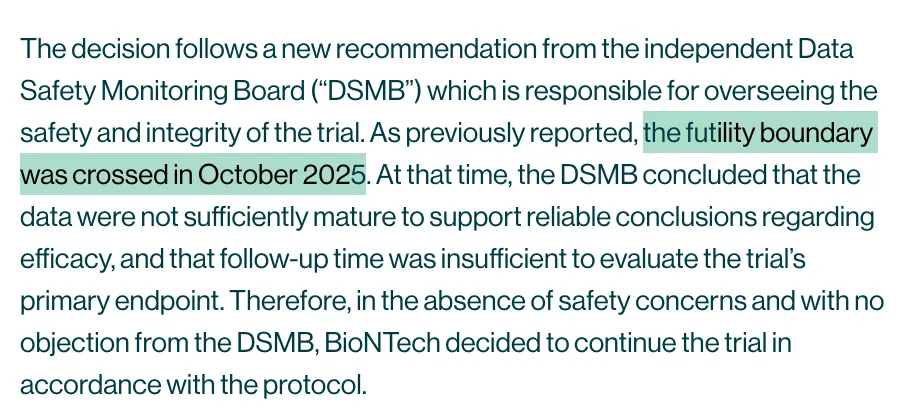
The company says the DSMB concluded at the time that the data were not mature enough to support reliable conclusions about efficacy and that follow-up was insufficient to evaluate the primary endpoint.
BioNTech therefore decided to continue the trial.
Ten months later, the DSMB found the overall-survival imbalance and recommended terminating it.
The chronology is therefore:
October 2025: Trial crosses its prespecified futility boundary.
BioNTech continues the trial.
August 2026: DSMB identifies an overall-survival imbalance.
Genentech confirms more deaths occurred in the vaccine arm.
BioNTech terminates the trial.
But BioNTech did not merely continue following patients already enrolled.
Public European trial records show that new patients continued to be recruited for months after the futility boundary was crossed.
According to the EU Clinical Trials Information System (CTIS), recruitment in Spain continued until February 9, 2026, while recruitment in Germany continued until April 28, 2026, or roughly six months after the October 2025 futility finding.
BioNTech has also disclosed that crossing the boundary had a specific consequence under the trial’s rules: the DSMB was “bound by its charter to make a non-binding recommendation to terminate the study.”
BioNTech nevertheless continued the trial and continued enrolling patients.
Then, in June 2026, BioNTech reported that another prespecified interim analysis had occurred and that the DSMB recommended “continuing the trial without modification.”
About two months later, the DSMB found the overall-survival imbalance and recommended termination.
That raises a straightforward question:
What information justified continuing to enroll patients after the trial had crossed its prespecified futility boundary and triggered a DSMB recommendation to terminate?
BioNTech Has Not Released the Death Counts
The company’s announcement does not disclose the number of deaths in either group, the overall-survival hazard ratio, the causes of death, or when the deaths occurred.
BioNTech instead says it will now conduct a “thorough analysis” and that the trial results will be shared with the scientific and medical community “at an appropriate time.”
The trial registry separately shows that investigators were tracking fatal treatment-emergent adverse events, including their assessed relationship to treatment.
Those results have not been disclosed in the materials reviewed here.
Bottom Line
BioNTech’s own documents establish that its mRNA cancer trial crossed a prespecified futility boundary in October 2025, requiring the DSMB under its charter to make a “non-binding recommendation to terminate the study.”
BioNTech nevertheless continued the trial.
And public European trial records show that new patients continued to be recruited for roughly six months after the futility finding.
In June 2026, BioNTech reported that another interim analysis resulted in the DSMB recommending that the trial continue without modification.
About two months later, the DSMB identified an imbalance in overall survival and recommended terminating the trial.
Genentech then supplied the crucial detail BioNTech’s announcement omitted:
“more deaths in the vaccine arm.”
That finding alone does not establish that autogene cevumeran caused the additional deaths.
But it leaves two immediate questions:
What justified continuing to enroll patients after the trial crossed its futility boundary and triggered a DSMB recommendation to terminate?
And how many patients died in each arm, what did they die from, and were any of those deaths attributed to the experimental treatment?
Your support is crucial in helping us defeat mass censorship. Please consider donating via Locals or check out our unique merch. Follow us on X @ModernityNews.
More news on our radar