



This post was published by Jon Fleetwood. Support him by subscribing at Substack and following at Instagram / X / Facebook.

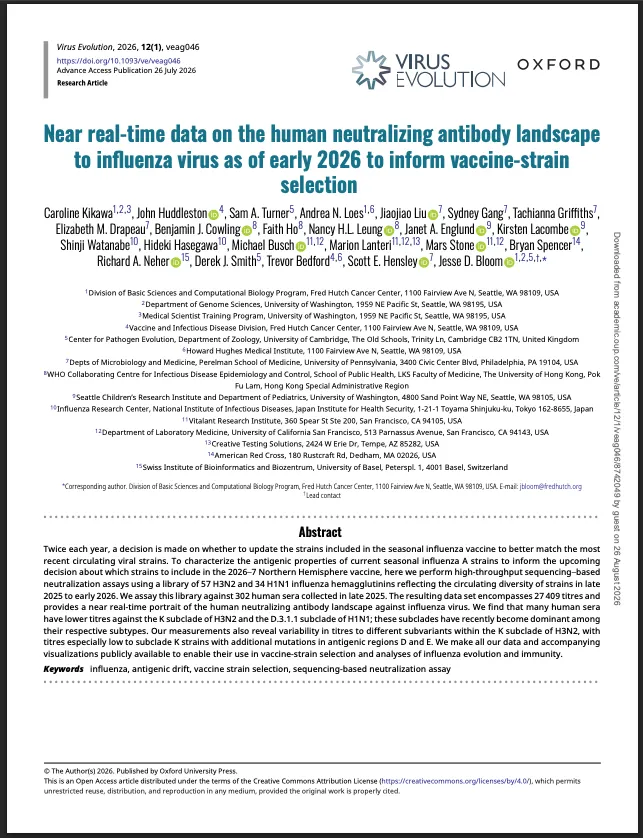
The U.S. Department of Health and Human Services (HHS) has funded research that claims to have created 186 new barcoded chimeric “Frankenstein” influenza virus variants, including laboratory-generated viruses that were harder for human antibodies to neutralize than other viruses tested.
The 2026 study, published in Virus Evolution, states:
“After quality control, we had a total of 186 unique barcoded viral variants for the 91 different HAs.”
These were not simply 186 influenza viruses collected from allegedly infected people.
Researchers claim to have built them.
Researchers say they used reverse genetics to build new chimeric viruses by taking a surface protein (hemagglutinin = HA) from modern human flu strains and combining it with the remaining genes of a laboratory-adapted flu virus from 1933.
The paper states:
“The barcoded viruses expressing each different library HA were generated using reverse genetics.”
Researchers then say they “passaged” the newly generated viruses in laboratory cells.
The paper claims that each virus carried a selected contemporary human influenza HA while “all the other genes” came from the lab-adapted 1933 virus.
In plain terms, researchers claim to have created chimeric influenza viruses containing parts associated with different influenza strains.

After COVID-19 demonstrated the potentially catastrophic consequences of a government-led pandemic response, why is HHS still financing the alleged creation of hundreds of new chimeric respiratory viruses, including constructs displaying enhanced immune-evasion phenotypes?
How could such government-funded research be used to trigger, justify, or shape another pandemic response?
What safeguards prevent the resulting sequences, constructs, experimental claims, and technical knowledge from being misused for biological-threat claims, weapons research, surveillance, or another government-led pandemic response?
You can contact NIAID here, NIH here, and HHS here to voice opposition to taxpayer-funded research on pandemic pathogens—particularly after Congress, the White House, the Department of Energy, the FBI, the CIA, and Germany’s Federal Intelligence Service (BND) all acknowledged that the COVID-19 pandemic was “likely” the result of a laboratory incident involving engineered pathogens.
Some Chimeras Were Said to Be Harder for Human Antibodies to Stop
Researchers say they exposed their newly constructed viruses to human blood serum to determine how effectively human antibodies could neutralize them.
Some of the chimeras were said to be harder to neutralize than others.
For H3N2, the researchers reported:
“subclade K is generally more poorly neutralized by human serum antibodies than other strains”
Some of the K viruses were said to be more resistant still.
Those carrying certain mutations in regions targeted by antibodies produced “especially low titres.”
The paper also claims to have found lower antibody neutralization against H1N1 D.3.1.1 viruses.
Its abstract reports that many human sera had lower titres against both H3N2 K and H1N1 D.3.1.1.
That means the experiment did more than create 186 chimeric influenza viruses.
Researchers created the purported viruses and then identified which of their laboratory-generated chimeras were comparatively better at escaping human antibodies.
The paper says the HA sequences themselves came from naturally occurring influenza strains and that researchers did not add non-natural amino-acid mutations to those HAs.
But the complete chimeric viruses did not come from patients.
Researchers claim to have assembled them by combining those contemporary HAs with the genes of a different, laboratory-adapted influenza virus.
HHS Money Funded the Experimental Work
The federal funding is explicit.
The paper states:
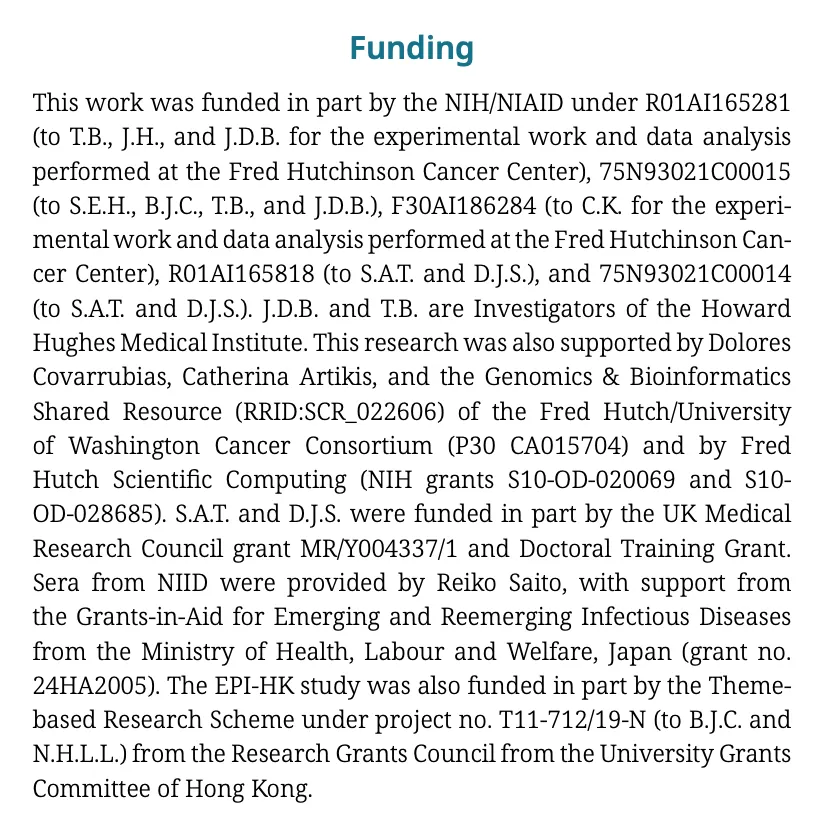
“This work was funded in part by the NIH/NIAID under R01AI165281”
The National Institutes of Health (NIH) and National Institute of Allergy and Infectious Diseases (NIAID) are agencies within HHS.
More importantly, the paper specifies that R01AI165281 supported:
“the experimental work and data analysis performed at the Fred Hutchinson Cancer Center”
The paper lists additional NIH/NIAID funding, including contracts 75N93021C00015 and 75N93021C00014, fellowship F30AI186284, and grant R01AI165818.
HHS was not the study’s only funding source, but federal HHS funding explicitly supported the experimental work.
Why Were 186 Chimeric Flu Viruses Created?
The researchers say the work is intended to measure which influenza variants are least affected by existing human antibodies and help anticipate influenza evolution.
The two groups showing particularly low neutralization (H3N2 K and H1N1 D.3.1.1) subsequently became dominant.
The authors concluded:
“rapid large-scale measurements of neutralization titres provide substantial information relevant to forecasting viral evolution.”
So researchers are not merely watching which alleged influenza variants emerge.
They are building chimeric versions in laboratories and testing which ones can best evade antibodies already present in humans.
That raises a basic question the paper itself does not answer:
Why should federally funded researchers physically create hundreds of new chimeric influenza viruses, including constructs displaying enhanced immune escape, to determine which viral configurations may have an advantage against human immunity?
Bottom Line
HHS funded experimental work in which researchers claim to have created 186 unique barcoded chimeric influenza viruses using reverse genetics.
The viruses combined contemporary human influenza HAs with genes from a lab-adapted 1933 influenza virus and were then grown in laboratory cells.
Researchers subsequently exposed those newly created viruses to human antibodies.
Some were said to be harder to neutralize than others.
The authors described H3N2 K viruses as “more poorly neutralized by human serum antibodies” and reported that some variants produced “especially low titres.”
The central fact is therefore simple:
Federal money supported the creation of 186 new chimeric influenza viruses, and the resulting laboratory virus collection included variants exhibiting enhanced immune escape relative to other pathogens tested.
Your support is crucial in helping us defeat mass censorship. Please consider donating via Locals or check out our unique merch. Follow us on X @ModernityNews.
More news on our radar