



This post was published by Jon Fleetwood. Support him by subscribing at Substack and following at Instagram / X / Facebook.

Congress has introduced legislation laying the groundwork for the next generation of global wireless infrastructure, openly directing the federal government to pursue “6G technology dominance” while integrating artificial intelligence systems, low-earth-orbit satellite networks, and worldwide telecommunications architecture into a centralized international strategy.
The move comes despite unresolved scientific questions surrounding the biological effects of radio frequency and terahertz radiation exposure that the public would likely be subjected to on a mass scale without individualized informed consent.
The bill, H.R. 8320—titled the “USA 6G Global Leadership Act”—was introduced on April 16, 2026, and referred to the House Committee on Energy and Commerce the same day.
6G is the proposed sixth-generation mobile communications technology, the planned successor to 5G, that is expected to deliver peak data rates up to 1 terabit per second, microsecond-level latency, and advanced capabilities such as integrated sensing and AI-native networking, with commercial deployment anticipated in the early 2030s.
The push for future 6G deployment also comes just years after the COVID-19 pandemic emerged alongside the unprecedented nationwide rollout of 5G infrastructure, including T-Mobile’s December 2019 launch covering more than 200 million people across over 5,000 cities and towns and more than 1 million square miles at once.
H.R. 8320 signals that U.S. officials are already preparing for large-scale deployment of emerging 6G systems expected to dramatically expand public exposure to AI-managed wireless infrastructure, satellite-linked communications systems, dense telecommunications networks, and future terahertz-frequency technologies.
Yet the legislation contains no provisions requiring long-term human biological safety studies, population-wide exposure monitoring, informed consent protections, or public opt-out mechanisms.
It was introduced by Rep. Julie Johnson (D-TX) and cosponsored by Rep. Sheri Biggs (R-SC), Rep. Michael Lawler (R-NY), and Rep. Brad Sherman (D-CA).
You can contact the bill’s authors by following the links in the above sentence, and by clicking here to find your representative, to demand proper long-term safety studies on 6G technology before the government tries to regulate it and expose us to it using American taxpayer dollars.
In December 2025, President Donald Trump signed a Presidential Memorandum directing the federal government to clear key spectrum bands for commercial 6G deployment.

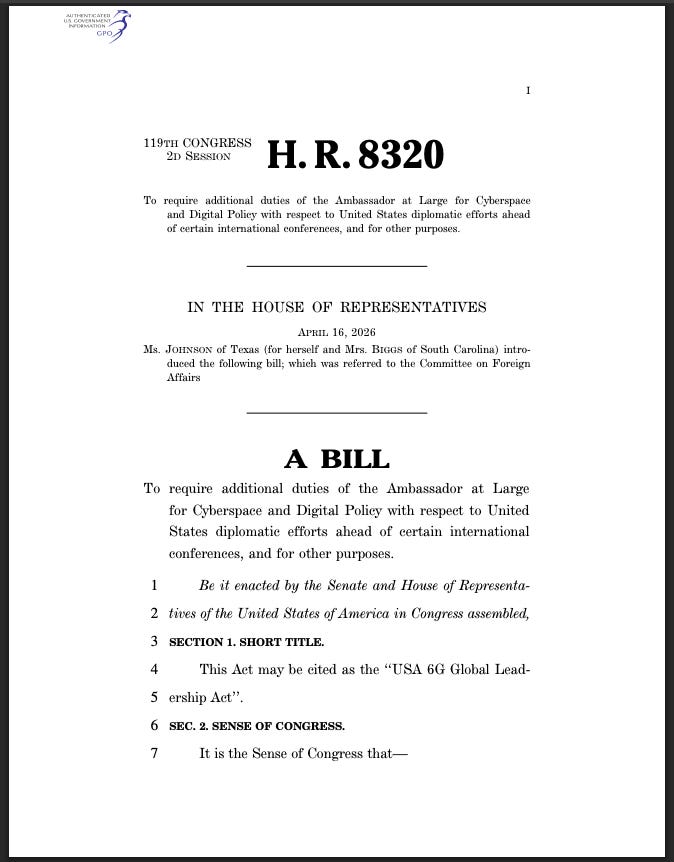
Bill Calls for U.S. ‘6G Dominance’

According to the legislation: “the United States has a national security, economic, and foreign policy interest in winning the race for 6G global leadership”
Unlike prior telecommunications legislation focused primarily on connectivity and internet speed, the bill repeatedly frames 6G as a strategic infrastructure platform tied to artificial intelligence systems, satellite networks, international standards control, and worldwide technological influence.
The legislation places the State Department’s Ambassador at Large for Cyberspace and Digital Policy in charge of coordinating U.S. diplomatic operations ahead of major International Telecommunications Union (ITU) conferences responsible for shaping future global telecommunications standards and spectrum governance.
Meaning federal officials are openly coordinating the architecture and governance framework for future wireless systems that populations would ultimately live within and be continuously exposed to.
AI Systems & Satellite Networks Embedded Into Future Wireless Infrastructure
The legislation directly links future 6G systems to artificial intelligence technologies and low-earth-orbit satellite infrastructure.
Specifically, the bill orders analysis regarding: “the effects on and impact of competition in artificial intelligence and other critical or emerging technologies, including the role of low-earth orbit satellites…”
That language suggests future 6G systems are expected to operate as part of an interconnected technological ecosystem combining:
- AI-managed communications systems
- satellite-integrated wireless infrastructure
- next-generation telecommunications standards
- global digital governance systems
- worldwide infrastructure deployment initiatives
In practical terms, that means populations could experience continuous exposure to increasingly dense and complex wireless radiation environments involving antennas, satellite-linked systems, AI-managed signal routing, and higher-frequency telecommunications infrastructure.
NIH Researchers Link Radio Frequency Radiation to Cancer
The legislation arrives years after the National Toxicology Program (NTP), part of the National Institutes of Health (NIH), concluded there was “clear evidence” that radio frequency radiation exposure like that used in 2G and 3G cell phone systems caused cancerous tumors in male rats.
According to the NIH release: “The National Toxicology Program (NTP) concluded there is clear evidence that male rats exposed to high levels of radio frequency radiation (RFR) like that used in 2G and 3G cell phones developed cancerous heart tumors.”
Federal researchers further stated: “We believe that the link between radio frequency radiation and tumors in male rats is real.”
The government-funded studies reportedly took more than a decade and approximately $30 million to complete and were described by NIH researchers as “the most comprehensive assessment, to date, of health effects in animals exposed to RFR.”
Importantly, the NIH researchers acknowledged that future wireless systems would require additional biological testing, stating: “5G is an emerging technology that hasn’t really been defined yet”
Despite those findings and uncertainties, nationwide 5G deployment continued.
Swedish Researchers Reported ‘Microwave Syndrome’ Symptoms After 5G Exposure
The legislation also arrives amid growing international concern over so-called “microwave syndrome” linked to 5G exposure.
A 2024 peer-reviewed review paper published in Reviews on Environmental Health summarized seven Swedish case reports involving 16 individuals between the ages of 4 and 83 who reportedly developed symptoms shortly after exposure to nearby 5G base stations.
According to the study:
“Most prevalent and severe were sleeping difficulty (insomnia, waking night time, early wake-up), headache, fatigue, irritability, concentration problems, loss of immediate memory, emotional distress, depression tendency, anxiety/panic, dysesthesia (unusual touched based sensations), burning and lancinating skin, cardiovascular symptoms (transitory high or irregular pulse), dyspnea, and pain in muscles and joints. Balance disorder and tinnitus were less prevalent. All these symptoms are included in the microwave syndrome.”
The study authors confirmed most symptoms “declined and disappeared within a short time period after the studied persons had moved to a place with no 5G.”
The researchers concluded: “They reinforce the urgency to inhibit the deployment of 5G until more safety studies have been performed.”
The study further stated: “It is clear from measurements made so far that the implementation of 5G has indeed caused a massive increase in human and environmental exposure to pulse-modulated RF radiation”
According to the paper, there were: “no studies available on biological effects on humans from exposure to the 5G frequencies around 3.5 GHz”
The paper additionally stated: “Thus, no study had investigated exposure similar to that encountered by millions of people now exposed to radiation from 5G antennas in combination with 4G technology.”
Chinese Military Scientists Studied Potential 6G Fertility Effects
According to reporting on research conducted by Chinese military scientists: “Terahertz waves – a type of electromagnetic radiation – are expected to play a pivotal role in future technologies like 6G communications.”
The report stated that gene sequencing revealed changes that: “could potentially hinder the ability of sperm to navigate, reducing fertility”
The article further stated that the observed effects potentially occurred at radiation levels below exposure limits currently permitted in the United States and other countries.
No Long-Term Human Safety Framework Included
Despite mounting scientific debate and emerging research into potential biological effects from advanced wireless radiation systems, the legislation contains no provisions requiring:
- long-term human safety trials
- population-wide biological monitoring
- informed consent protections
- cumulative lifetime exposure studies
- public opt-out mechanisms
- long-term reproductive health tracking
- mandatory pre-deployment safety evaluations
Instead, the legislation focuses overwhelmingly on accelerating U.S. technological dominance, infrastructure deployment, AI integration, satellite-linked communications systems, and international standards coordination ahead of future 6G rollout.
Bottom Line
If enacted, H.R. 8320 would formalize a centralized U.S. strategy for rapidly deploying AI-integrated 6G infrastructure across society.
Embedding populations inside an increasingly dense web of satellite-linked, higher-frequency wireless radiation systems despite unresolved cancer, neurological, reproductive, and “microwave syndrome” concerns, no long-term human safety framework, and no meaningful mechanism for individualized informed consent before exposure.
Your support is crucial in helping us defeat mass censorship. Please consider donating via Locals or check out our unique merch. Follow us on X @ModernityNews.
More news on our radar