



This post was published by Jon Fleetwood. Support him by subscribing at Substack and following at Instagram / X / Facebook.

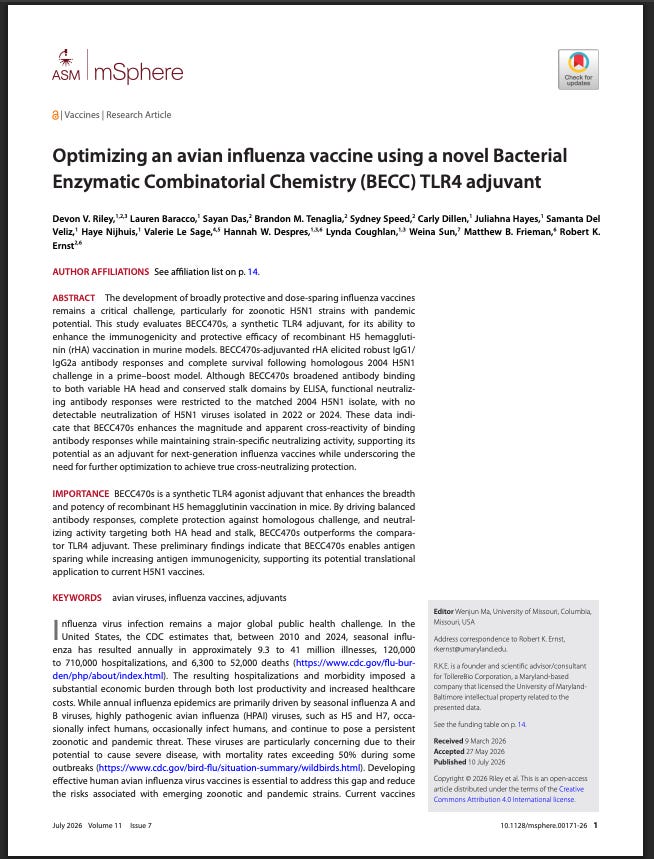
The Department of Health and Human Services (HHS) is funding research on an experimental vaccine for future H5N1 bird flu pandemic response that combines a chimeric (“Frankenstein”) H5 bird-flu protein with a synthetic copy of an engineered lipid component of Yersinia pestis, the bacterium that causes plague.
The move comes as President Donald Trump recently filled two posts at the top of the government’s pandemic orchestration apparatus, Sara Brenner now leading the White House pandemic office and H5N1-linked Rachel Idowu taking over NSC bioresponse.
Researchers in the new study claim to have tested their vaccine by challenging mice with a second chimera: an engineered H5N1/PR8 influenza virus assembled from parts of two different influenza viruses.
The findings were published last month in the American Society for Microbiology journal mSphere.
The vaccine contains recombinant H5 hemagglutinin (HA) from the H5N1 bird-flu virus A/Vietnam/1203/2004, but the protein is said not simply to be an unchanged copy of the virus’s native H5 protein.
Researchers say they replaced its native transmembrane portion with a heterologous fibritin foldon, creating an H5 protein containing a component from another biological source.
The vaccine’s immune-stimulating ingredient is even more unusual.
Called BECC470s, it is a synthetic copy of an engineered form of lipid A, the biologically active lipid component of bacterial endotoxin.
The molecule’s development traces directly to engineered Yersinia pestis: researchers first produced the BECC470 lipid-A structure using an altered strain of the bacterium that causes plague, before chemically synthesizing BECC470s as a purified version of that structure.
The researchers then challenged vaccinated mice with a chimeric influenza virus said to contain two genome segments from H5N1 bird flu and six segments from another influenza virus, PR8.
All of it is occurring in the context of preparing medical countermeasures against a purported H5N1 virus the researchers characterize as presenting a pandemic threat.
And American taxpayers are paying for it.
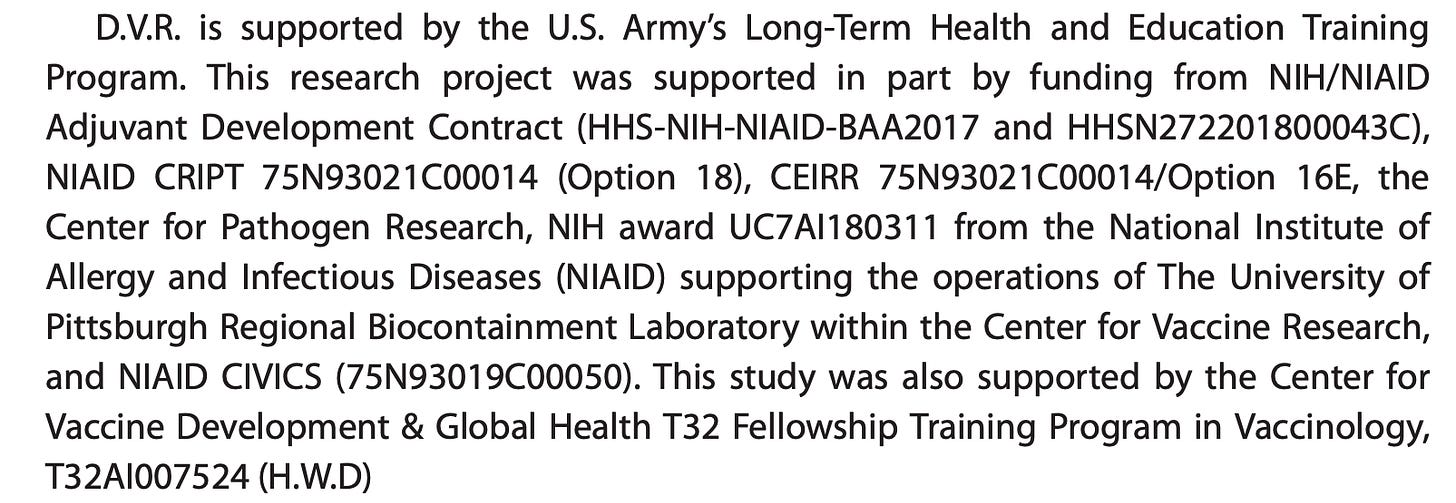
The paper identifies funding from an HHS/NIH/NIAID Adjuvant Development Contract and numerous other federal programs.
You can contact NIAID here, NIH here, and HHS here to voice opposition to taxpayer-funded plague component-containing vaccines and research involving pandemic pathogens like influenza—particularly after Congress, the White House, the Department of Energy, the FBI, the CIA, and Germany’s Federal Intelligence Service (BND) all acknowledged that the COVID-19 pandemic was “likely” the result of a laboratory incident involving engineered pathogens.
The Vaccine Contains a Synthetic Copy of a Component Engineered in Plague Bacteria
BECC470s is the adjuvant in the experimental vaccine, the ingredient intended to activate the immune system.

Physically, BECC470s is an engineered lipid A molecule.
Lipid A is the lipid portion of the outer-membrane lipopolysaccharide, or LPS, of Gram-negative bacteria and is responsible for much of endotoxin’s biological activity.
The history of this particular molecule leads directly to Yersinia pestis.
A 2023 study describing BECC470s says researchers developed the underlying technology through Bacterial Enzymatic Combinatorial Chemistry, or BECC.
According to the researchers, BECC was used to generate novel lipid-A structures in an “attenuated Yersinia pestis (Yp) isolate.”
The researchers identify two versions of the resulting BECC470 molecule:
- BECC470b — the biological version produced from the engineered plague bacterium.
- BECC470s — the synthetic version subsequently made chemically.
The methods leave little ambiguity about the biological version’s physical origin.
Researchers cultured the corresponding Y. pestis KIM6+ strain, collected the bacterial cells, extracted their lipooligosaccharide and then separated out the lipid-A portion.
The authors themselves describe BECC470b as coming from its biological Y. pestis source.
Researchers subsequently chemically recreated that engineered lipid-A structure as BECC470s.
The paper says the synthetic version was produced using proprietary chemical methods and was more than 99% pure.
So the physical-development chain is clear:
Yersinia pestis, the plague bacterium
?
engineered Y. pestis lipid A
?
biologically produced BECC470b
?
synthetic copy, BECC470s
?
H5N1 bird-flu vaccine
The vaccine does not contain whole Y. pestis bacteria.
The BECC470s put into the vaccine is the chemically manufactured version of the engineered lipid-A molecule, rather than material physically extracted from a current batch of plague bacteria.
But the molecule being copied was developed as an engineered component of Y. pestis.
And it’s added to the drug intentionally to trigger a response from the body.
BECC470s Retains Inflammatory Activity
Researchers claim to have altered the bacterial lipid precisely because lipid A can produce unwanted endotoxin-associated effects.
BECC470s is a hexa-acylated, monophosphorylated lipid-A structure.
So it lacks a 4? phosphate present in the related bis-phosphorylated BECC438s molecule.
The researchers explain that phosphate groups are important to the endotoxin activity of lipid-A molecules.
But BECC470s was not engineered to eliminate lipid A’s biological activity altogether.
The researchers want it to continue stimulating the immune system.
They specifically tested BECC470 and related molecules for their ability to activate TLR4 and NF-?B, describing this experiment as measuring their ability to “potentially cause inflammation.”
BECC470s activated the pathway.
The researchers found that its NF-?B activation was lower than biologically produced BECC470, but nevertheless concluded that BECC470s continued to function as a TLR4 agonist.
That is the engineering objective: reduce the undesirable toxicity associated with bacterial lipid A while retaining enough of its inflammatory immune-stimulating activity to make it useful in vaccines.
The researchers claim that BECC470s was not toxic in a single-dose rabbit acute-toxicity model conducted by Labcorp.
However, the published paper provides virtually no details about the experiment.
Including the dose tested, number of animals, administration route, observation period, or toxicological endpoints.
Making it impossible from the publication alone to independently assess the scope of that finding.
The Bird-Flu Vaccine Protein Is Chimeric
The plague-derived molecular design is not the vaccine’s only engineered component.
The H5 bird-flu protein used as the vaccine antigen is itself an engineered hybrid, or chimeric, protein.
Researchers claim to have started with H5 hemagglutinin from A/Vietnam/1203/2004 H5N1.
But they did not simply manufacture an unchanged copy of that viral protein.
The study says researchers replaced H5’s native transmembrane domain with a heterologous fibritin foldon trimerization motif.
“Heterologous” means the replacement comes from a different biological source.
The resulting vaccine antigen is said to combine H5 bird-flu protein with a foreign fibritin foldon component.
Put plainly, it is a chimeric H5 vaccine protein: part of the construct is H5 influenza HA, while another part has been replaced with a non-H5 protein element.
Researchers then combined this chimeric H5 protein with 50 micrograms of BECC470s, the synthetic engineered lipid-A adjuvant whose design traces to Y. pestis.
So the experimental vaccine itself brings together: a chimeric H5 bird-flu protein + a synthetic copy of an engineered plague-bacterium lipid component.
Researchers Used Another Chimera to Test the Vaccine
Researchers then say they tested the vaccine against a second chimera.
The virus used for the principal mouse challenge was not an untouched H5N1 virus.
It was said to be an engineered 6:2 influenza reassortant, meaning its eight genome segments were assembled from two different influenza viruses.
Two segments (the genes encoding H5 and N1) came from A/Vietnam/1203/2004 H5N1.
The remaining six genome segments came from A/Puerto Rico/8/1934, commonly called PR8.
In plain English, researchers created an H5N1/PR8 influenza chimera carrying the purported H5 and N1 surface components of bird flu on the six-segment internal genetic backbone of a different influenza virus.
Researchers made another alteration to the H5 component: they removed its polybasic cleavage site.
The resulting HALo configuration was designed to be low-pathogenic.
So this study does not document scientists making H5N1 more pathogenic.
It documents researchers using an engineered, attenuated influenza chimera to test an experimental vaccine made with plague components.
The paper credits Mount Sinai researcher Weina Sun with supplying the PR8/H5 virus used in the study.
The experiment therefore contains two separate alleged chimeras:
- Chimera No. 1 — the vaccine antigen: an H5 bird-flu protein containing a foreign fibritin foldon component.
- Chimera No. 2 — the challenge virus: an H5N1/PR8 influenza virus assembled from genome segments belonging to two different influenza viruses.
Between them sits BECC470s, the synthetic version of an engineered lipid-A molecule originally produced through the plague bacterium.
HHS Funds the Research
American taxpayers funded the research through several federal programs.
The study identifies support from an NIH/NIAID Adjuvant Development Contract: HHS-NIH-NIAID-BAA2017 / HHSN272201800043C
The research also received support through NIAID CRIPT, the Centers of Excellence for Influenza Research and Response (CEIRR), NIAID CIVICS and NIH funding supporting operation of the University of Pittsburgh Regional Biocontainment Laboratory.
Lead author Devon Riley was separately supported by the U.S. Army’s Long-Term Health and Education Training Program.
The institutional network included the University of Maryland, University of Pittsburgh and Icahn School of Medicine at Mount Sinai.
The researchers explicitly place their work in the context of the threat posed by potentially pandemic avian influenza.
Their experimental vaccine is therefore part of a federally financed effort to develop medical countermeasures that could be used for future H5N1 pandemic response.
The study itself does not establish that HHS has selected this particular experimental formulation for public deployment or that Americans will be required to receive it.
It establishes something narrower but concrete: HHS is spending taxpayer money to develop and evaluate this technology as a prospective H5N1 vaccine.
Commercial IP
The taxpayer-funded research also connects to privately licensed intellectual property.
Senior author Robert K. Ernst disclosed that he is a founder and scientific adviser/consultant to TollereBio Corporation.
The mSphere paper states that TollereBio licensed University of Maryland-Baltimore intellectual property related to the data presented in the study.
The paper does not identify TollereBio as the manufacturer of a finished H5N1 vaccine.
It does establish that intellectual property associated with the federally supported research has already been licensed to a private company connected to one of the study’s senior researchers.
The chain therefore extends beyond the laboratory: taxpayer-funded pandemic-vaccine research ? university intellectual property ? private commercial license.
Bottom Line
American taxpayers are financing H5N1 pandemic-preparedness research involving two chimeras, an engineered plague-bacterium derivative, inflammatory TLR4 activation, and privately licensed commercial IP.
The vaccine pairs a chimeric bird-flu antigen with BECC470s—a synthetic version of lipid A first engineered through Yersinia pestis—and researchers say they tested it against a separate H5N1/PR8 influenza chimera.
BECC470s is intentionally designed to retain inflammatory immune stimulation while reducing lipid A’s toxicity, yet the published acute-toxicity claim rests on a single-dose rabbit test for which virtually no methodological details are provided.
All of it is being developed with HHS/NIH/NIAID funding for future pandemic response, while related university intellectual property has already been licensed to a private company connected to the study’s senior author.
Your support is crucial in helping us defeat mass censorship. Please consider donating via Locals or check out our unique merch. Follow us on X @ModernityNews.
More news on our radar