



This post was published by Jon Fleetwood. Support him by subscribing at Substack and following at Instagram / X / Facebook.

The Trump administration’s newly released “United States Government Policy for Stopping High-Risk Life Sciences Research” says it prohibits federally supported dangerous gain-of-function research, but the policy also creates a new category of “Potential DGOF Research” that may still receive federal approval and expressly states that purely computational research used to “design novel forms of biological agents” is not prohibited, according to the policy document.
That means American tax dollars will continue funding experiments said to make biological agents like pathogens more harmful to humans, and will continue to fund the computer design of brand new GOF biological agents.
The policy, released Tuesday by the Department of Health and Human Services (HHS), fulfills President Donald Trump’s executive order on biological research and replaces previous federal oversight frameworks with what officials describe as a unified, risk-based system.
In announcing the policy, HHS claims that it “prohibits federally supported dangerous gain-of-function (DGOF) research” while preserving biomedical research under new oversight safeguards.
But the policy discusses these three distinct categories of research: Dangerous Gain-of-Function (DGOF) Research, Potential DGOF Research, and purely computational (in silico) biological-agent design.
Each is treated differently.
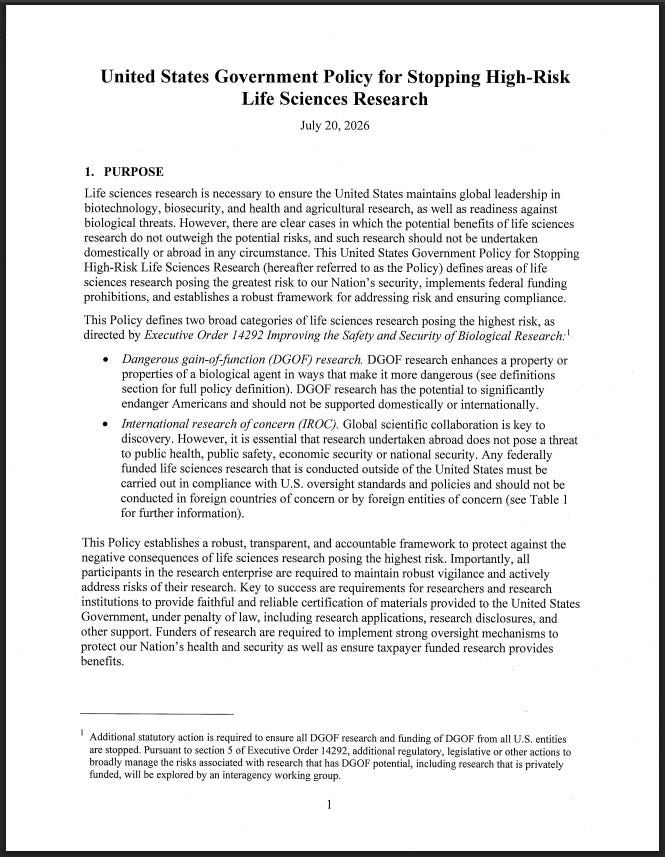
The Policy Defines DGOF by Seven High-Risk Outcomes
Rather than defining dangerous gain-of-function research by specific pathogens or laboratories, the policy defines it by the biological characteristics a project seeks to create.
According to the policy, DGOF Research is research involving a biological agent that seeks, achieves, or has a substantial risk of achieving one or more of the following outcomes:
- Enhancing the harmful consequences of the biological agent.
- Disrupting beneficial immunological response or the effectiveness of an immunization.
- Conferring resistance to therapeutic interventions or facilitating the agent’s ability to evade detection.
- Increasing the stability, transmissibility, or ability to disseminate the biological agent.
- Altering the host range or tropism of the biological agent.
- Enhancing the susceptibility of human, animal, or plant populations to the biological agent.
- Generating or reconstituting an eradicated or extinct biological agent.
Funding research meeting that definition is “Prohibited.”
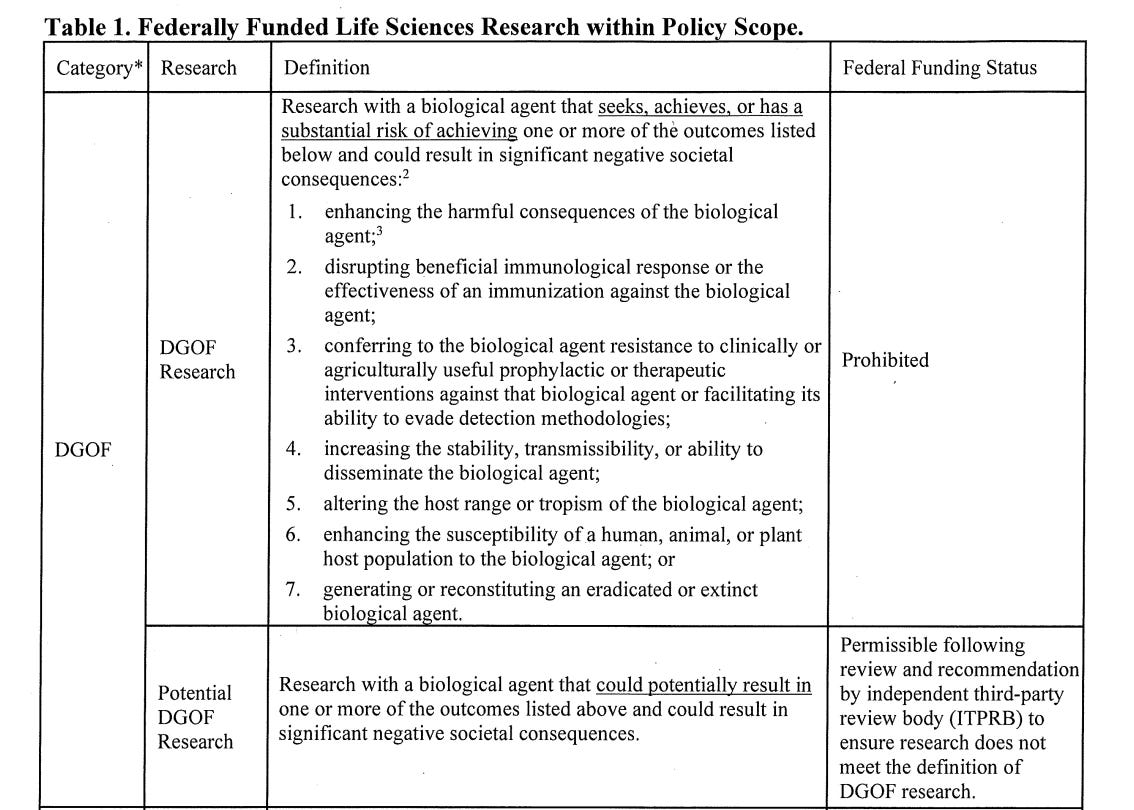
What Is a ‘Biological Agent’?
A “biological agent” is defined by the policy as any microorganism, infectious material, or other component capable of causing death, disease, and harm in living organisms.
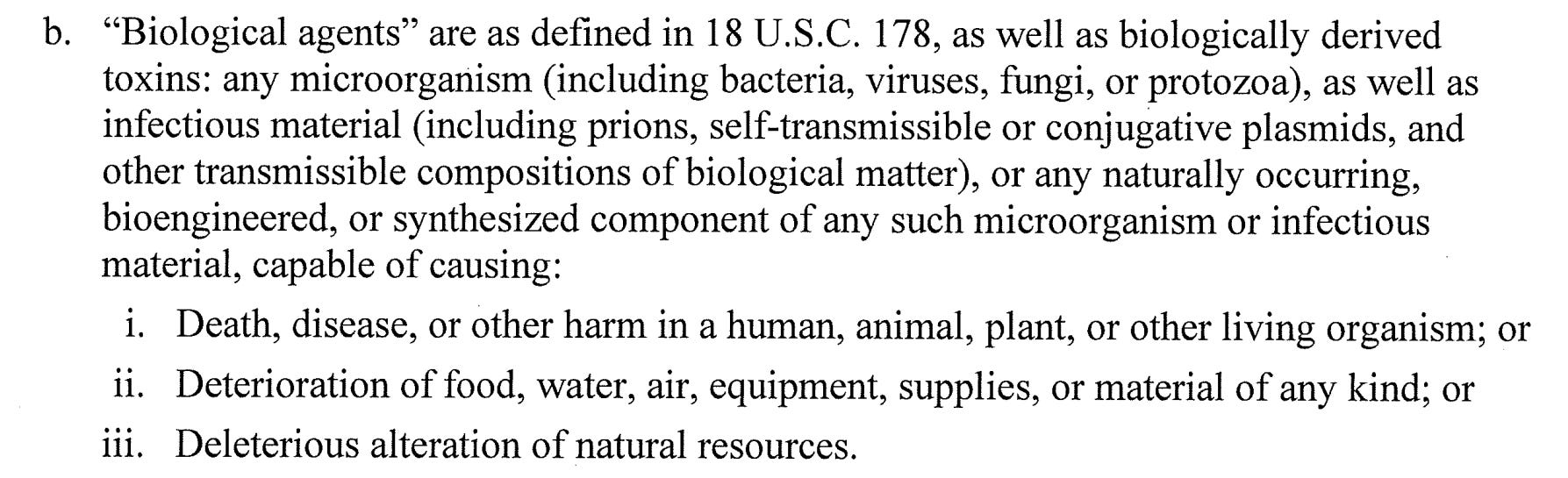
Those Same Seven Outcomes Define ‘Potential’ DGOF Research
The policy then creates a second category called Potential DGOF Research.
Rather than using different biological characteristics, the policy defines Potential DGOF by reference to the same seven outcomes listed above.
It states that Potential DGOF Research is research involving a biological agent that “could potentially result in one or more of the outcomes listed above” and could result in significant negative societal consequences.

Unlike DGOF Research, however, Potential DGOF Research is not automatically prohibited.
Instead, Table 1 states that Potential DGOF Research is “Permissible following review and recommendation by [an] Independent Third-Party Review Body (ITPRB)” to ensure the proposed research does not meet the policy’s definition of DGOF Research.

In other words, the same seven high-risk biological outcomes that define prohibited DGOF Research also define the scope of what the policy classifies as Potential DGOF Research.
The difference is not the biological characteristics themselves, but how the proposed research is ultimately classified under the policy’s review process.
The policy therefore leaves several fundamental questions unanswered:
- Who decides whether research involving enhanced harmfulness, immune evasion, increased transmissibility, altered host range, therapeutic resistance, or the other listed outcomes is merely “Potential DGOF” rather than prohibited DGOF?
- Who appoints the Independent Third-Party Review Body?
- Will its members be disclosed?
- Will its recommendations be made public?
The policy Explicitly Allows In Silico Design of ‘Novel’ Biological Agents
The policy also contains a separate provision governing purely computational—or in silico—research.
It states: “[P]urely computational (i.e., in silico) research that may include development of computational models and software, or may use such means to design novel forms of biological agents, is not prohibited by this policy unless it involves an entity of concern.”
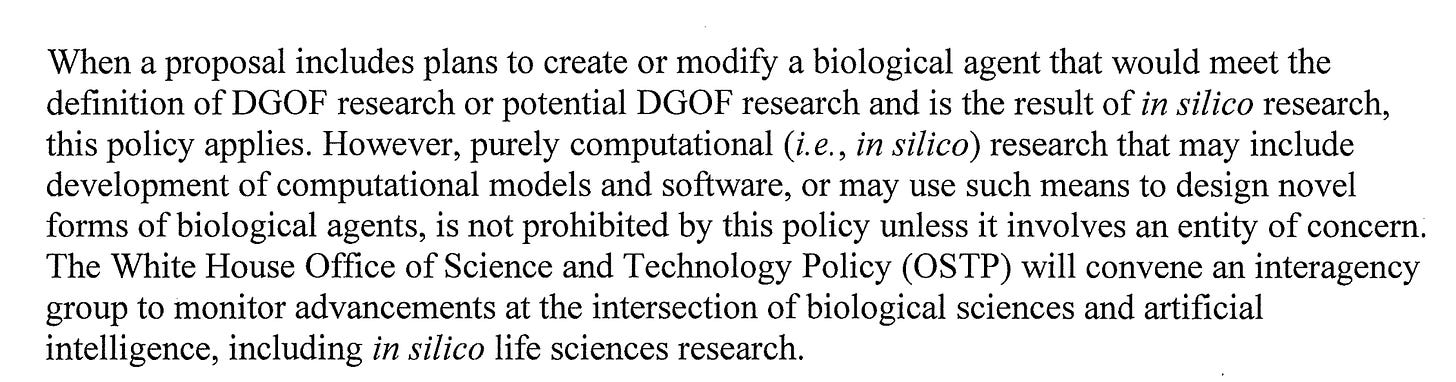
That provision is significant because the policy is not discussing analysis of existing biological agents.
It expressly addresses using computers to design never-before-seen forms of biological agents.
Read together with the policy’s DGOF definitions, the document allows funding for the computational design of biological agents possessing enhanced harmfulness, immune evasion, therapeutic resistance, increased transmissibility, altered host range, increased host susceptibility, and the in silico generation or reconstitution of eradicated or extinct biological agents.
Bottom Line
The administration says this policy ends federally funded dangerous gain-of-function research.
But the policy itself tells a more complicated story.
Rather than simply prohibiting research involving enhanced harmfulness, immune evasion, therapeutic resistance, increased transmissibility, altered host range, increased host susceptibility, or generating or reconstituting eradicated or extinct biological agents, the policy creates a second category—Potential DGOF Research—defined by those same seven high-risk outcomes.
Unlike DGOF Research, that category is allowed to proceed following review.
In other words, the policy does not eliminate research involving those seven categories of high-risk outcomes.
It creates a pathway under which research that could potentially produce those same outcomes may still receive federal approval if it is classified as Potential DGOF rather than prohibited DGOF.
Who decides which projects fall into which category?
The policy says an Independent Third-Party Review Body will make recommendations, yet it never identifies who those reviewers are, who appoints them, what standards they will apply in practice, whether their deliberations will be public, or whether Americans will ever know which projects they approved.
The policy also expressly states that using computers to “design novel forms of biological agents” is not prohibited.
You can contact HHS here to voice opposition to taxpayer-funded GOF research of any form—particularly after Congress, the White House, the Department of Energy, the FBI, the CIA, and Germany’s Federal Intelligence Service (BND) all acknowledged that the COVID-19 pandemic was “likely” the result of a laboratory incident involving engineered pathogens.
Your support is crucial in helping us defeat mass censorship. Please consider donating via Locals or check out our unique merch. Follow us on X @ModernityNews.
More news on our radar