



This post was published by Jon Fleetwood. Support him by subscribing at Substack and following at Instagram / X / Facebook.

In a June Request for Information (RFI) titled “Protection Before Day One Vaccine: Advancing Broadly Protective Seasonal Influenza Vaccines with Pandemic Coverage,” the U.S. Department of Health and Human Services (HHS) is asking the biotechnology industry to develop influenza vaccines before the next pandemic begins, reflecting a level of planning that treats another influenza pandemic as a matter of when, not if.
HHS is therefore confident that there will be a future determination by authorities that an influenza pandemic has begun.
The proposal follows a series of federal future influenza pandemic-orchestrating initiatives, including Congress seeking $3.3 billion for a future influenza pandemic, HHS funding experiments determining how to make H5 influenza more pathogenic, HHS funding the creation of never-before-seen chimeric H6Nx bird flu viruses said to carry immune-evasion traits, and DARPA/NIH-funded scientists reprogramming dormant influenza parts with new replication and competition-suppressing functions.
It also comes after U.S. taxpayers funded the research behind Moderna’s new mRNA-1010 influenza vaccine and an FDA—which is under HHS—advisory committee backed the shot despite providing less than a 1% absolute benefit.
The initiatives raise a fundamental national security question: Why is the government simultaneously investing in making influenza viruses more dangerous while preparing “Day One” vaccines for the influenza pandemic it appears to expect?
You can contact HHS here to ask why the agency is planning for another influenza pandemic while simultaneously funding research that seeks to increase the capabilities of influenza viruses (see list of many such projects at the end of this article).
The RFI lists Wendy Rehman (wendy.rehman@ati.org) as the “Primary Point of Contact” for the Protection Before Day One Vaccine project.
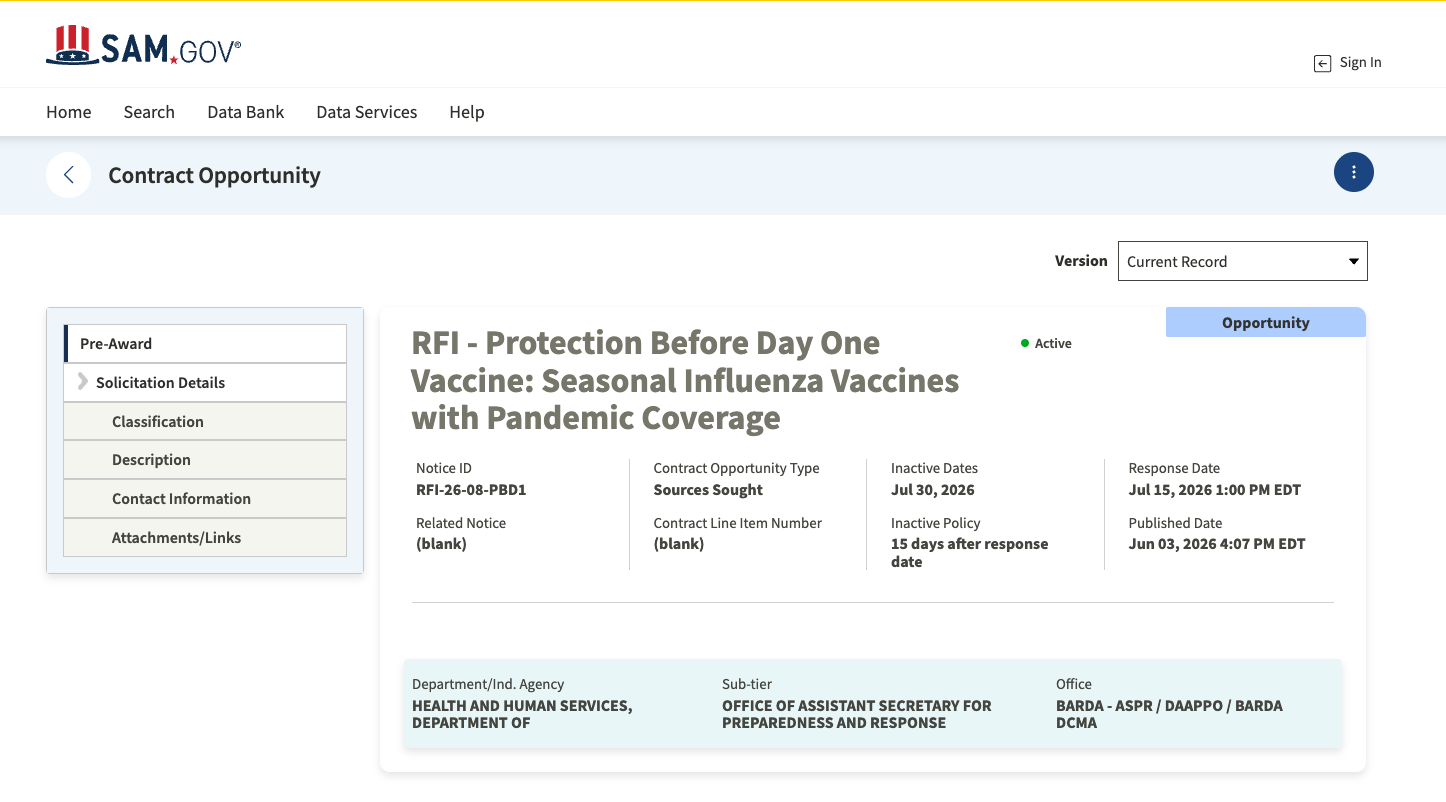

Before ‘Day One’
BARDA’s proposal centers on what it calls “Day One” vaccines—vaccines the agency advertizes as already providing some level of immunity when the next influenza pandemic begins.
According to BARDA, the concept is intended to address what the agency describes as a critical weakness in current pandemic preparedness.
According to the RFI: “A critical vulnerability in current pandemic preparedness is the time required—typically at least three months—between identification of a novel pandemic strain and deployment of strain-matched vaccines at scale.”
BARDA says that even if manufacturers could accelerate production, governments would still face a period during which no strain-matched vaccine was widely available.
Instead of simply asking how to shorten that timeline, the agency is asking the biotechnology industry whether that interval can effectively be eliminated by developing vaccines already in use before the next influenza pandemic begins.
The agency says those “Day One” vaccines would: “Deliver seasonal influenza protection”
and: “Provide partial protection against emerging pandemic influenza viruses at the onset of a Public Health Emergency.”
In other words, BARDA is asking whether routine seasonal influenza vaccination can also serve as the government’s first-line response to a future influenza pandemic before a strain-matched vaccine becomes available.

BARDA presents that objective as a preparedness strategy.
It also raises broader questions.
If governments are pursuing vaccines intended for use before the next influenza pandemic begins, what assumptions are being made about how future pandemics will be anticipated, identified, and declared?
And as governments simultaneously invest in both experiments that increase the capabilities of influenza viruses and vaccines intended for future influenza pandemics, what national security, oversight, and public accountability questions does that combination inevitably raise?
Treating the Next Pandemic as Inevitable
BARDA’s Request for Information repeatedly assumes another influenza pandemic will occur.
Rather than limiting the effort to alleged influenza strains circulating today, the agency says it is seeking vaccines capable of: “Providing inferred or demonstrated cross-protection against one or more potential pandemic influenza subtypes; e.g., H2, H5, H7, H9.”
The proposal repeatedly refers to:
- “emerging pandemic influenza viruses,”
- “potential pandemic influenza subtypes,”
- “viruses with pandemic potential,”
- and “pre-pandemic strains.”
The initiative is not limited to improving seasonal influenza vaccines.
It is structured around BARDA’s expectation that another influenza pandemic will emerge and asks industry to build vaccines intended to be in widespread use before that occurs.
How is BARDA so confident?
‘Prediction’ as the Foundation
Prediction appears throughout BARDA’s proposal.
The agency cites previous modeling (in-the-computer) studies to justify the concept behind “Day One” vaccines, stating: “Prior modeling studies have demonstrated that a modestly effective but rapidly distributed vaccine can provide a greater benefit than a highly efficacious but delayed vaccine.”
BARDA further states: “Modeling suggests that Day One vaccines can not only reduce the total number of infections and peak infection rate but also delay the peak to allow more time for strain-matched pandemic vaccines to become available.”
The agency also instructs respondents to submit: “modeling assumptions or data supporting expected impact.”
In addition, BARDA seeks proposals incorporating: “Novel correlates of protection and immune-bridging strategies.”
The proposal repeatedly relies on computer modeling, assumptions, and inferred measures to support vaccine development for future influenza pandemics.
That reliance raises another set of questions.
- If predictive models and inferred measures are expected to guide decisions before a pandemic occurs, how will those models be validated before they influence public health policy?
- What assumptions determine whether a vaccine is expected to work against viruses that have not yet emerged?
- And if those assumptions later shape vaccine recommendations, funding decisions, or emergency responses, what opportunities will exist for independent scientists and the public to scrutinize the underlying models rather than simply accepting their conclusions?‘
Inferred’ Pandemic Protection
Another recurring feature of BARDA’s proposal is its reliance on the concept of “inferred” protection.
Rather than limiting its objective to demonstrated protection against pandemic influenza, BARDA’s preferred Target Product Profile calls for vaccines that provide: “Indicated for prevention of seasonal influenza and inferred protection against pandemic influenza.”
The agency also instructs respondents to: “Describe the proposed pathway for inferring pandemic benefit.”
The proposal therefore does not ask only how protection against a future pandemic influenza virus could be demonstrated.
It explicitly asks companies to explain how that protection could instead be inferred.
Science ordinarily distinguishes between what has been directly observed and what has been inferred from other evidence.
Yet BARDA is asking industry to develop a pathway for inferring protection against a pandemic that has not yet occurred.
What evidence would regulators ultimately accept as sufficient to make that inference?
At what point does a scientific inference become treated as established evidence for national vaccination policy?
And how much uncertainty remains once an inference is translated into a regulatory decision?
Predictive ‘Biosignatures’
BARDA’s proposal goes beyond asking whether a vaccine produces a measurable immune response.
According to the agency, its preferred vaccine would: Establish “a biosignature that is reasonably predictive against viruses with pandemic potential.”
The proposal also asks companies to include: “Breadth panel (including pre-pandemic strains).”
And explain: “whether vaccine is intended to prime for rapid boost with strain-matched vaccine.”
But prediction is not the same thing as demonstration.
A biosignature may be measurable today, but its ability to predict protection against a future pandemic virus cannot be directly observed until that future virus actually exists and people are exposed to it.
Yet BARDA is asking industry to develop biological markers that regulators may ultimately rely upon before that real-world evidence can exist.
What, then, transforms a predictive biosignature from an unverified scientific hypothesis into evidence accepted for regulatory decision-making?
If the prediction cannot be empirically confirmed before the pandemic it is meant to predict, on what scientific basis is the prediction considered sufficiently reliable to guide national vaccination policy?
Bottom Line
BARDA’s proposal makes clear that HHS is not merely preparing to respond if another influenza pandemic occurs.
BARDA is confident authorities will declare and respond to a pandemic in the future.
So much so that it’s asking the biotechnology industry to develop vaccines intended to be in widespread use before the next pandemic begins.
To accomplish that, the agency is asking companies to rely not only on traditional clinical evidence, but also on predictive modeling, inferred pandemic protection, immune-bridging strategies, and biological markers said to predict protection against viruses with future pandemic potential.
The proposal raises the question many Americans are likely to ask after COVID-19: Is the federal government merely preparing for another influenza pandemic—or is it actively laying the scientific, regulatory, and commercial groundwork necessary to orchestrate one?
Your support is crucial in helping us defeat mass censorship. Please consider donating via Locals or check out our unique merch. Follow us on X @ModernityNews.
More news on our radar