



This post was published by Jon Fleetwood. Support him by subscribing at Substack and following at Instagram / X / Facebook.

Buried inside the House version of the Fiscal Year 2027 National Defense Authorization Act (NDAA) is language that appears to ban U.S. military gain-of-function research on pandemic pathogens—before immediately creating a waiver allowing it to receive taxpayer funding anyway.
The pandemic pathogen-enhancing waiver comes even though the defining traits of the SARS-CoV-2 pathogen at the center of the COVID-19 pandemic were developed through U.S. funding.
The waiver also comes after more than a decade in which the U.S. military itself, largely through DARPA, funded a succession of programs that this publication has reported collectively built the infrastructure for designing “future” pathogen characteristics, constructing their wildlife backstories, and rapidly deploying the pharmaceutical and surveillance systems needed to operationalize them.
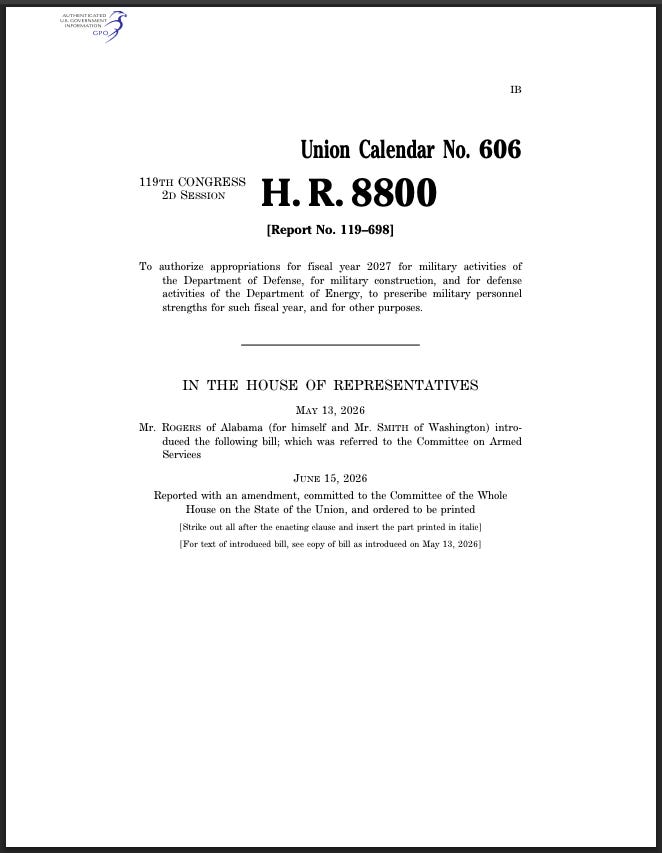
The new legislation, H.R. 8800, authorizes roughly $1.15 trillion in military spending across 1,614 pages.
You can contact the author of the bill—U.S. Representative Mike Rogers (R-AL)—here, House members here, and Senate members here to let them know what you think of the bill.
The Prohibition (Before the Waiver)
Section 236 begins with what appears to be a sweeping prohibition:
“None of the funds authorized to be appropriated by this Act or otherwise made available for fiscal year 2027 for the Department of Defense may be obligated or expended—
(1) to conduct gain-of-function research on any potential pandemic pathogen at any facility operated by or on behalf of the Department; or
(2) to award contracts, grants, cooperative agreements, or any other form of financial assistance to any institution of higher education, nonprofit organization, private entity, or other research institute that is conducting gain-of-function research on potential pandemic pathogens.”
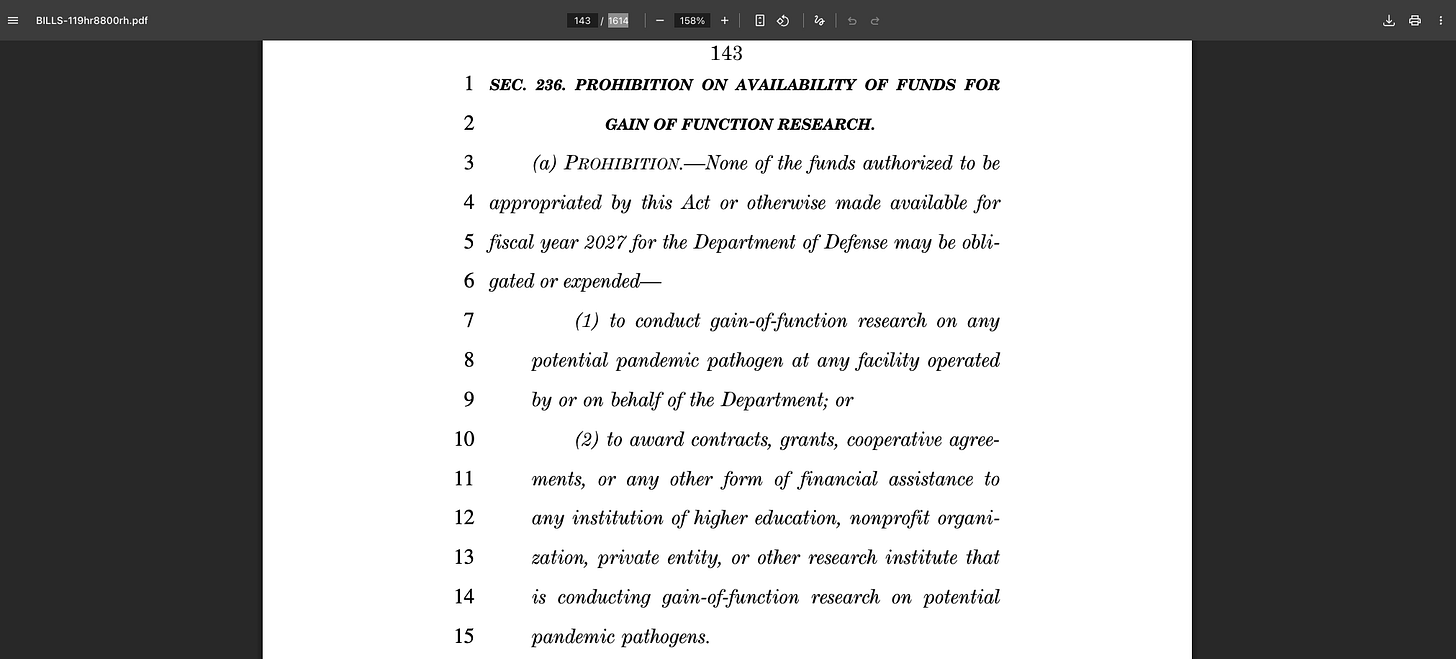
The prohibition covers not only military laboratories themselves, but also universities, nonprofits, private companies, and outside research institutes receiving Defense Department money.

The Waiver
Then comes the waiver.
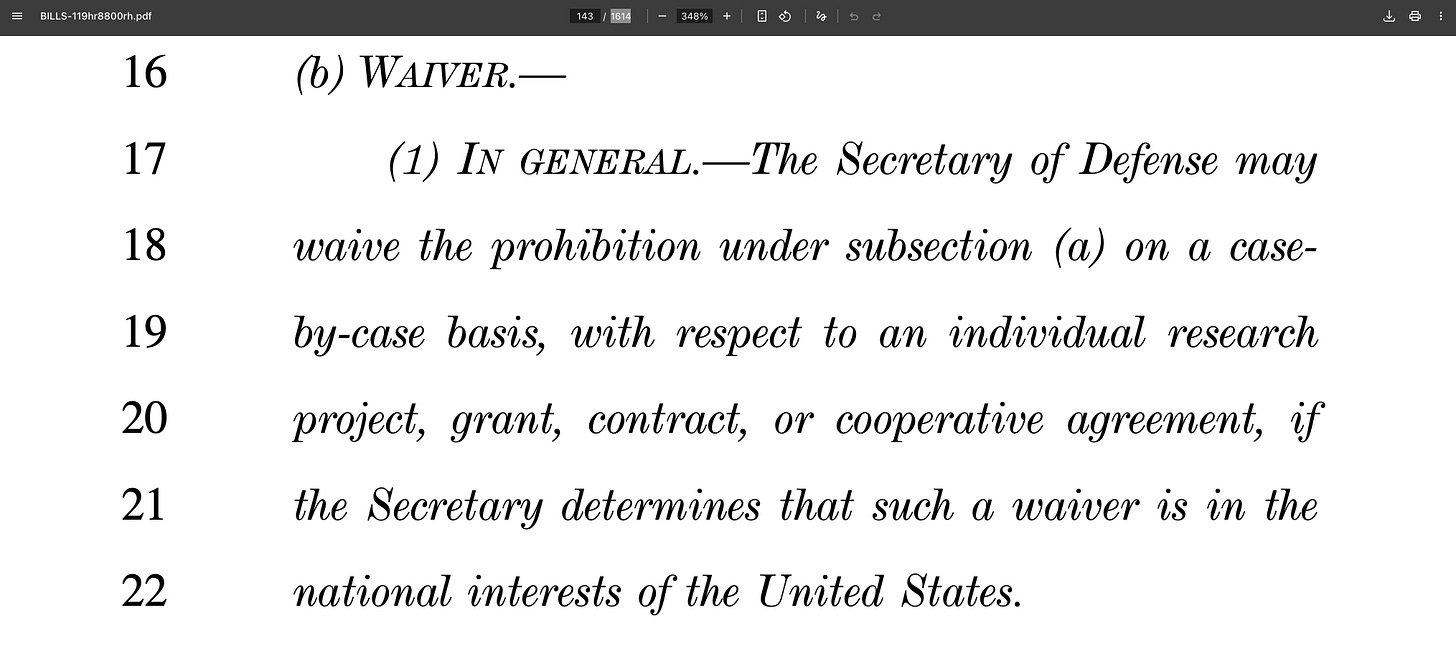
The very next subsection states:
“The Secretary of Defense may waive the prohibition under subsection (a) on a case-by-case basis, with respect to an individual research project, grant, contract, or cooperative agreement, if the Secretary determines that such a waiver is in the national interests of the United States.”
The only requirement is notification.
According to the bill:
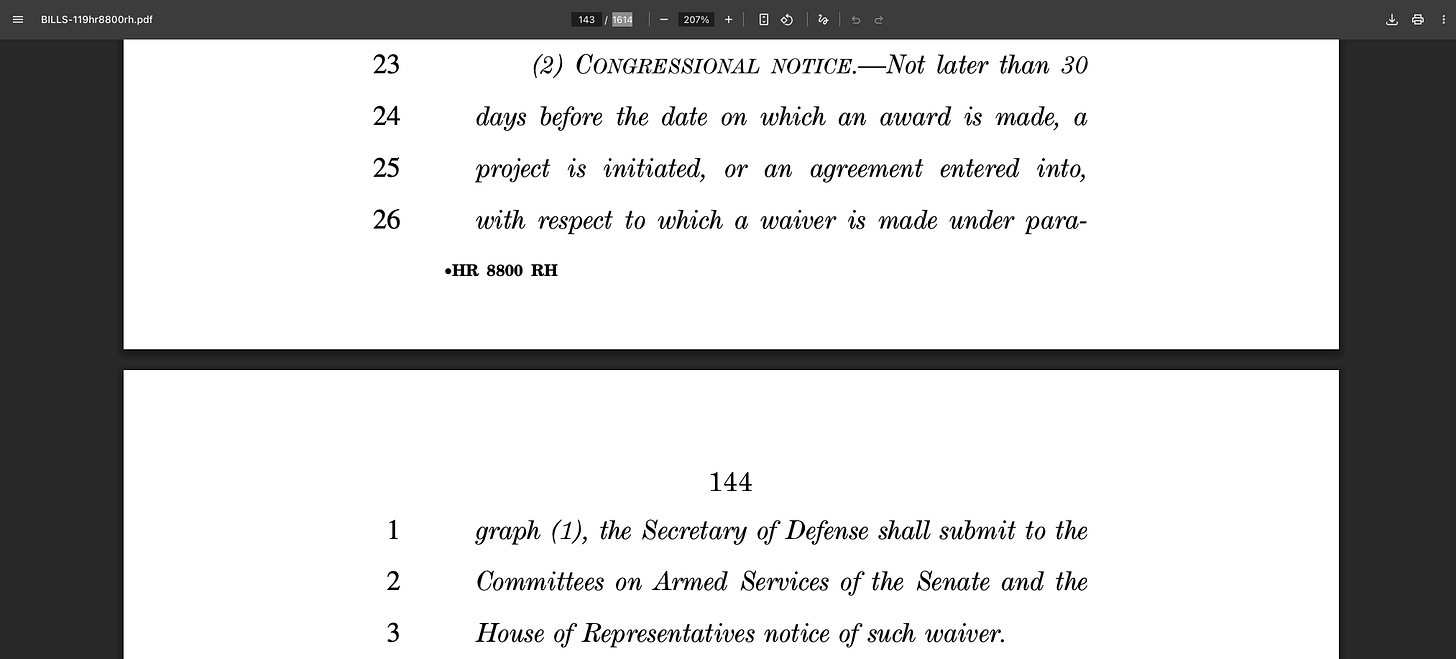
“Not later than 30 days before the date on which an award is made, a project is initiated, or an agreement entered into, with respect to which a waiver is made … the Secretary of Defense shall submit to the Committees on Armed Services of the Senate and the House of Representatives notice of such waiver.”
Congressional approval is not required.
The Secretary of Defense merely has to notify Congress that the military intends to proceed with the work.
Bill Defines GOF
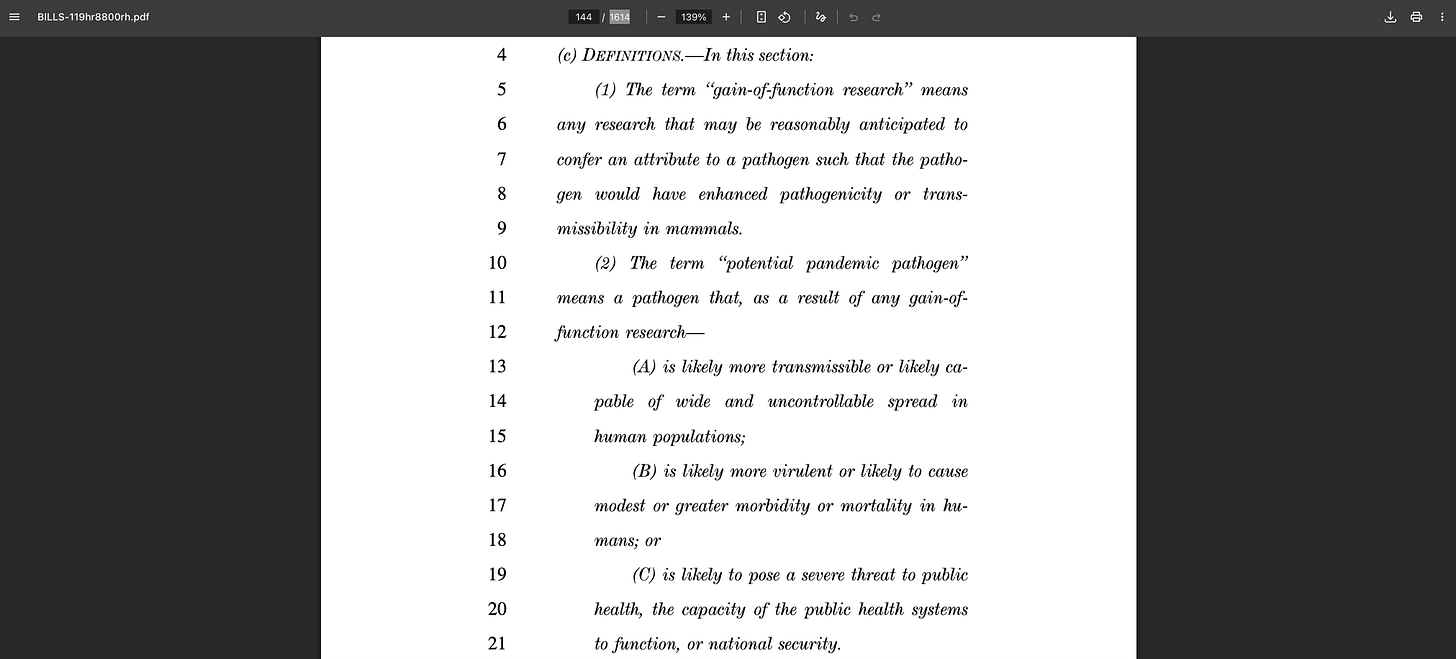
The legislation also provides an unusually direct definition of gain-of-function research:
“The term ‘gain-of-function research’ means any research that may be reasonably anticipated to confer an attribute to a pathogen such that the pathogen would have enhanced pathogenicity or transmissibility in mammals.”
Meanwhile, the bill defines a “potential pandemic pathogen” as one that, through gain-of-function research:
“(A) is likely more transmissible or likely capable of wide and uncontrollable spread in human populations;
“(B) is likely more virulent or likely to cause modest or greater morbidity or mortality in humans; or
“(C) is likely to pose a severe threat to public health, the capacity of the public health systems to function, or national security.”
In plain English, the legislation authorizes the Defense Secretary to approve experiments intended to create purported pathogens that are more transmissible, more virulent, more difficult to control, or more threatening to public health systems and national security—provided the Pentagon determines doing so serves the “national interest.”
Congress, the White House, the Department of Energy, the FBI, the CIA, and Germany’s Federal Intelligence Service (BND) all acknowledged that the COVID-19 pandemic was “likely” the result of a laboratory incident involving engineered pathogens.
Which raises questions as to whether the bill itself, especially through the GOF waiver, is the real threat to national and international security.
Bottom Line
If gain-of-function research on purported pandemic pathogens is so dangerous that Congress felt compelled to prohibit it, then creating a national-security waiver that allows the exact same experiments to continue raises obvious questions about what the prohibition was ever intended to accomplish in the first place.
The Pentagon is not seeking authority to study harmless microbes or obscure laboratory organisms.
The bill specifically contemplates research involving purported pathogens that could become “more transmissible,” “more virulent,” and “capable of wide and uncontrollable spread in human populations.”
That is not the language of defensive medicine.
It is the language of pandemic-capable biological agents and bioweapons.
Perhaps most remarkably, this authority is being sought only a few years after what much of the U.S. government itself now believes was a laboratory-associated pandemic involving an engineered pathogen.
If the lesson policymakers took from COVID is that government agencies should retain the ability to enhance the characteristics of potential pandemic pathogens whenever they determine it serves the “national interest,” then many Americans may reasonably conclude that the institutions claiming to protect the public from biological threats have instead become some of the largest generators of those risks themselves.
At minimum, Congress has now placed into statute the proposition that the U.S. military should retain the authority to fund research designed to make potential pandemic pathogens more dangerous—provided the Secretary of Defense signs off on it and sends Congress a letter 30 days in advance.
Your support is crucial in helping us defeat mass censorship. Please consider donating via Locals or check out our unique merch. Follow us on X @ModernityNews.
More news on our radar