



This post was published by Jon Fleetwood. Support him by subscribing at Substack and following at Instagram / X / Facebook.

The World Health Organization (WHO) is demanding that governments complete negotiations on a permanent international system for transporting purported pathogens with pandemic potential and their proxies across the world, while simultaneously claiming that another pandemic is likely within the coming decade.
The proposal raises biosafety, international security, and national sovereignty questions about whether an unelected international organization should coordinate a permanent system for the cross-border movement of pathogens with pandemic potential and related biological materials and data.
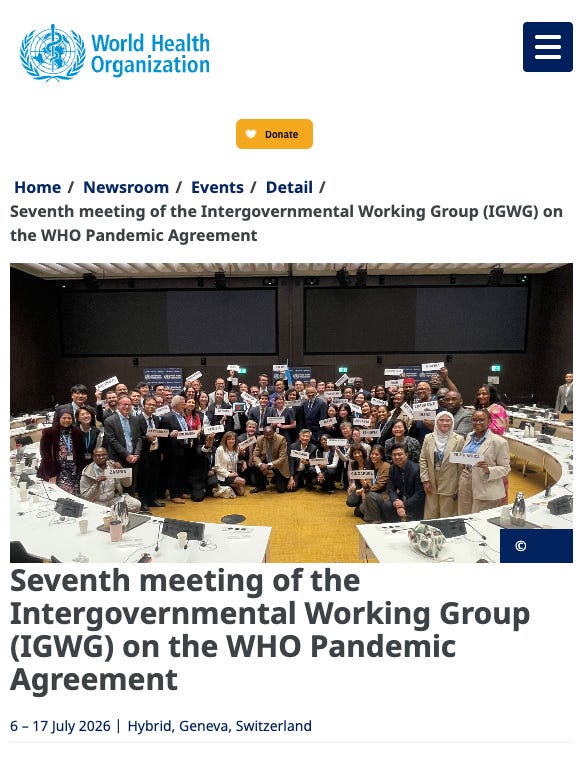
The push comes as delegates from WHO Member States meet in Geneva from July 6 through July 17 to negotiate the final operational rules for the Pathogen Access and Benefit-Sharing (PABS) System, the last major component needed before the WHO Pandemic Agreement can enter into force.
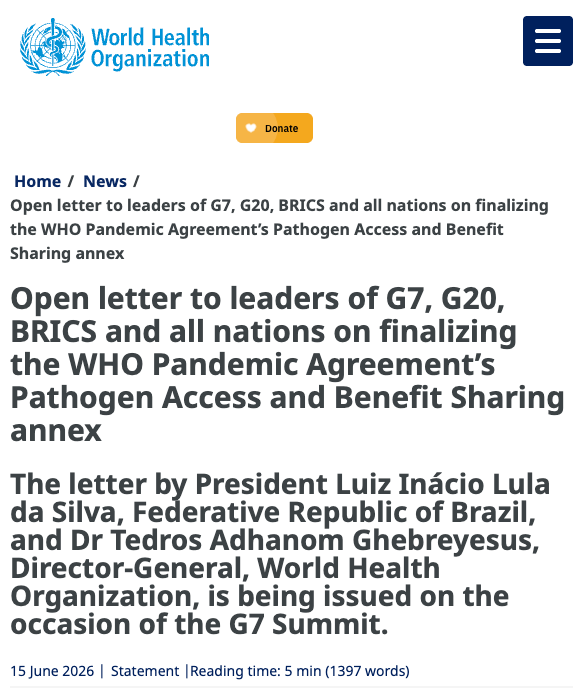
In an open letter to leaders of the G7, G20, BRICS and “all nations,” WHO Director-General Dr. Tedros Adhanom Ghebreyesus and Brazilian President Luiz Inácio Lula da Silva insisted that heads of government intervene personally to ensure the negotiations are completed this month. “The next pandemic will not wait for us,” the letter states. “Scientists estimate there is close to a one in four chance of another pandemic within the coming decade, and the ground beneath our old assumptions is shifting.”
The WHO is asking governments to treat the negotiations with urgency. “So we ask you to treat 17 July as a deadline, not a milestone,” the letter states, urging leaders to send “the unambiguous signal that this is the round in which the work is finished.”
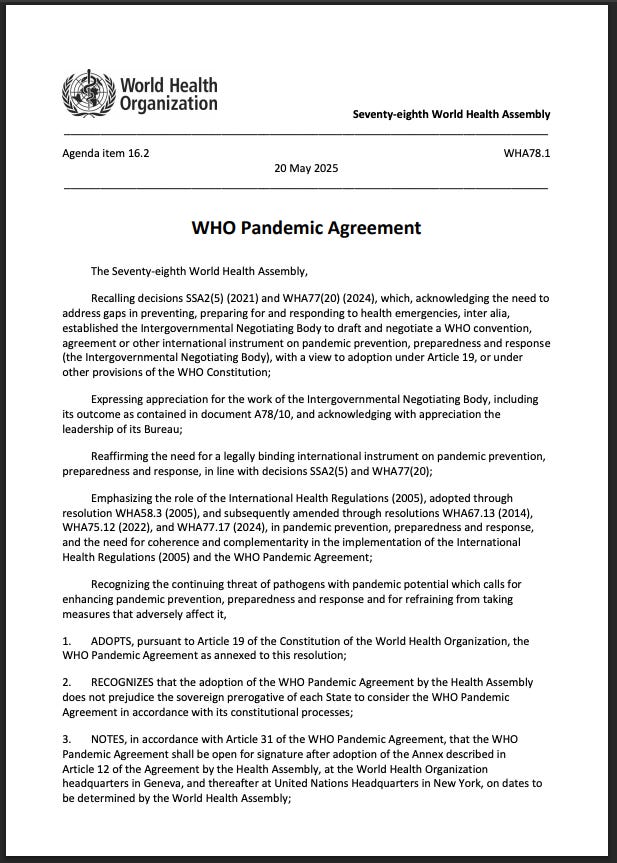
At the center of those negotiations is Article 12 of the WHO Pandemic Agreement, which establishes the WHO Pathogen Access and Benefit-Sharing (PABS) System, with negotiators drafting “legally binding contracts to be negotiated and signed with WHO.”
The treaty states that the Parties: “hereby establish a multilateral system for safe, transparent, and accountable access and benefit-sharing for PABS Materials and Sequence Information, the ‘WHO Pathogen Access and Benefit-Sharing System’.”
Rather than limiting the system to genetic sequence data, the treaty repeatedly refers to both “materials and sequence information on pathogens with pandemic potential.”
The WHO’s public appeal likewise describes the system as involving more than digital genetic information.
According to the letter: “To respond to future pandemics in time, countries must be able to quickly identify pathogens with pandemic potential and share their genetic information and material so scientists can develop tools: the tests, the treatments, the vaccines that decide who lives and who does not.”
Elsewhere, the WHO describes the purpose of the PABS system even more directly. “The PABS system rests on a simple, fair bargain,” the letter states. “Those who share dangerous pathogens quickly must be able to trust that the vaccines and treatments born from that sharing will reach their own people too.”
The letter argues that the framework replaces what it describes as an ad hoc approach to pathogen access. “Today the rules for accessing a pathogen and sharing what flows from it are improvised case by case, often mid-crisis. PABS replaces that with a single framework known in advance, stable rules that let laboratories and partners across the world move at the speed an outbreak demands.”
Article 12 similarly states that the PABS Instrument must contain provisions governing: “the rapid and timely sharing of PABS Materials and Sequence Information” together with the sharing of benefits arising from their use.
PABS will contain provisions regarding: “implementation consistent with applicable international law and with applicable national and/or domestic law, regulations and standards related to risk assessment, biosafety, biosecurity and export control of pathogens.”
Those provisions raise broader questions about how an international pathogen-sharing system will function once the operational annex is finalized, including which pathogen materials will be exchanged, who will receive them, what laboratories will qualify to participate, and what oversight mechanisms will govern international transfers.
The WHO itself acknowledges in the same letter that: “Advances in biotechnology, matched unevenly by biosafety, raise the risk of accidental or deliberate release.”

Despite that acknowledgment, the organization argues that completing the PABS annex is essential.
“Until it is finished, the Agreement cannot enter into force,” the letter states. “The promise stays unkept.”
The WHO’s latest push also comes as the organization continues to face criticism over its handling of COVID-19.
In its final report, the U.S. House Select Subcommittee on the Coronavirus Pandemic concluded: “The WHO’s response to the COVID-19 pandemic was an abject failure because it caved to pressure from the Chinese Communist Party and placed China’s political interests ahead of its international duties. The WHO’s newest effort to solve the problems exacerbated by the COVID-19 pandemic—via a ‘Pandemic Treaty’—may harm the United States.”
Bottom Line
The WHO is urging governments to rapidly complete a permanent international framework for dispersing purported pathogens with pandemic potential, their biological materials, and associated sequence information worldwide, while warning that another pandemic is likely within the next decade.
The proposal raises broader biosafety and international security questions about whether expanding the international movement of such pathogens with pandemic potential or their proxies could also increase opportunities for accidental release, diversion, theft, misuse, or fraud.
Your support is crucial in helping us defeat mass censorship. Please consider donating via Locals or check out our unique merch. Follow us on X @ModernityNews.
More news on our radar
The only pandemic we should see is a massive breakout of “Noose Fever”.