



This post was published by Jon Fleetwood. Support him by subscribing at Substack and following at Instagram / X / Facebook.

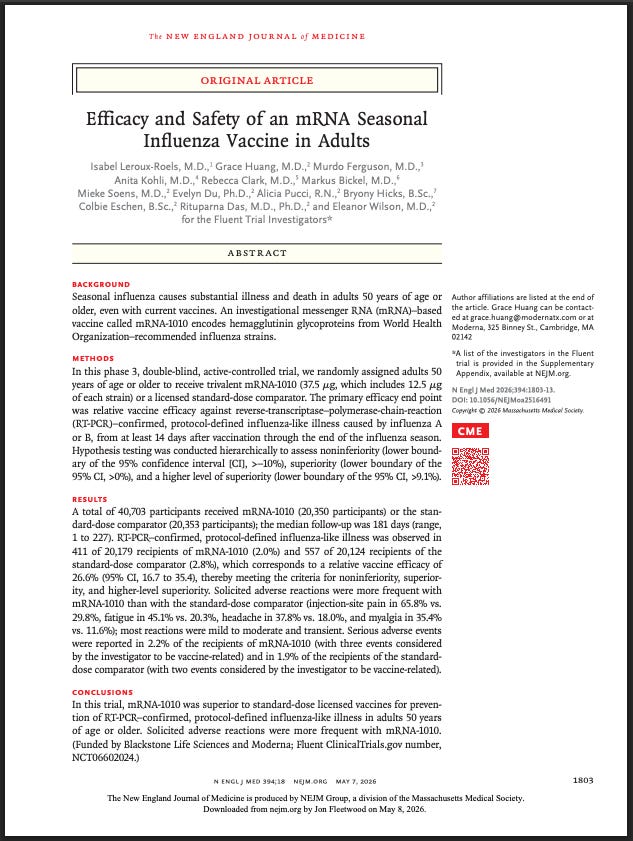
A newly published New England Journal of Medicine Phase 3 trial has confirmed that Moderna’s experimental mRNA seasonal influenza vaccine, mRNA-1010, caused severe short-term reactions at roughly six times the rate of standard-dose flu shots while delivering less than a 1-percentage-point absolute reduction in symptomatic, PCR-confirmed influenza-like illness.
The study found that recipients of the mRNA flu shot experienced dramatically more severe short-term side effects, while the overall difference in influenza illness between the two groups remained small.
The trial, published on Thursday, evaluated more than 40,000 adults aged 50 and older across 301 clinical sites in 11 Northern Hemisphere countries during the 2024–2025 influenza season.
The new study compared Moderna’s trivalent mRNA-1010 shot against licensed standard-dose influenza vaccines, not the enhanced high-dose, adjuvanted, or recombinant flu vaccines already recommended for many older adults.
That distinction is important because the study did not prove Moderna’s shot performed better than the said-to-be strongest influenza vaccines currently available for seniors.
Instead, it showed alleged superiority only against older standard-dose flu shots.
Researchers reported that PCR-confirmed, protocol-defined influenza-like illness occurred in 2.0% of mRNA-1010 recipients compared with 2.8% of standard-dose flu shot recipients—a 0.8-percentage-point absolute difference that the paper framed as 26.6% relative vaccine efficacy.
For the average reader, that means the “26.6% better” headline sounds much larger than the actual real-world difference observed in the study population.
More than 97% of participants in both groups did not develop the study’s primary endpoint.
At the same time, Grade 3 solicited adverse reactions—severe reactions that interfere with normal activity—occurred in 6.4% of mRNA-1010 recipients compared with 1.0% of standard-dose flu shot recipients.
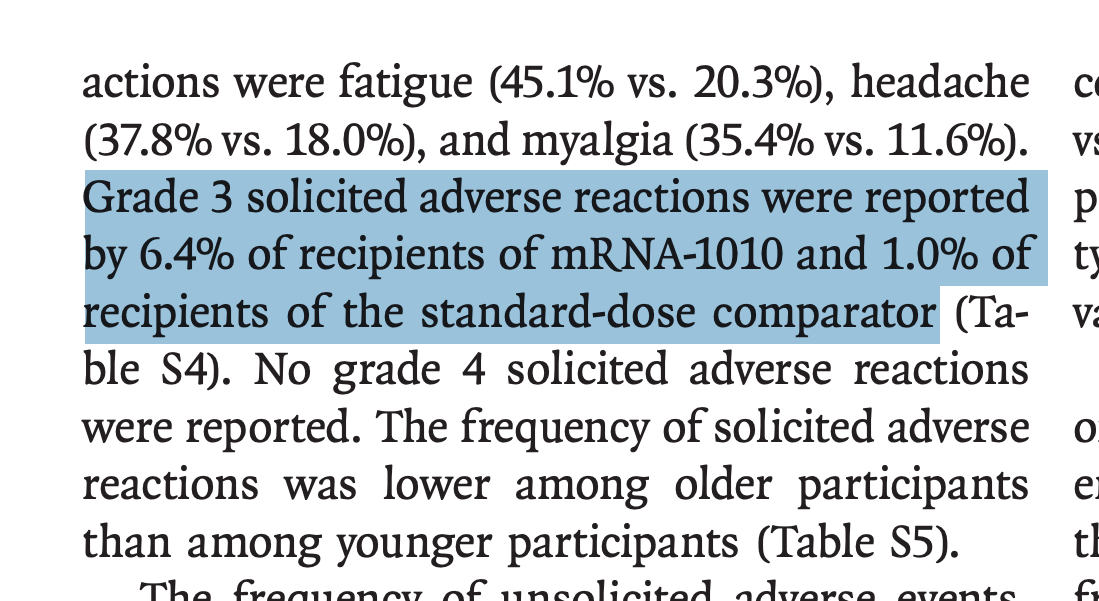
The mRNA group also experienced sharply higher rates of fatigue, headache, muscle pain, chills, and injection-site pain.
That means approximately 1 in 16 recipients of the mRNA flu shot experienced a severe short-term reaction serious enough to disrupt daily activity, compared with roughly 1 in 100 recipients of standard flu shots.
The study did not prove reductions in death, ICU admission, or major influenza complications.
Hospitalizations were reported in only 4 mRNA recipients and 8 comparator recipients, and the authors acknowledged the trial was not powered for those outcomes.
Meaning the study was not designed to determine whether the mRNA flu shot meaningfully reduced severe influenza outcomes such as hospitalization or death.
The study was funded by Blackstone Life Sciences and Moderna, and Moderna was responsible for the trial design, site selection, monitoring, and data analysis.

The manuscript was also prepared by Moderna employees with help from medical writers funded by Moderna.
In other words, the company developing the product also designed the study, analyzed the data, and helped write the final paper presenting the results.
That raises conflict-of-interest concerns, but also means the company itself has confirmed that its experimental mRNA flu shot produced dramatically higher severe reaction rates while delivering only a small absolute reduction in symptom-defined, PCR-confirmed influenza illness.
Moderna was created through funding from the Defense Advanced Research Projects Agency (DARPA), a secretive U.S. military research arm with little public oversight and a history (here) of dual?use experimentation.
Severe Reactions Were Approximately 6 Times Higher
One of the most striking findings involved Grade 3 adverse reactions.
According to the paper: “Grade 3 solicited adverse reactions were reported by 6.4% of recipients of mRNA-1010 and 1.0% of recipients of the standard-dose comparator.”
Grade 3 reactions are generally classified as severe reactions that interfere with normal daily activity.
That means recipients were not simply reporting mild soreness or fatigue.
These were reactions serious enough to disrupt work, routine movement, or ordinary day-to-day functioning.
The roughly sixfold increase in severe reactions becomes especially significant when compared against the relatively small absolute reduction in influenza illness observed in the trial.
Fatigue, Headaches, Muscle Pain, & Chills Were Dramatically Higher
The study reported substantially higher reaction rates in the mRNA group:
- injection-site pain: 65.8% vs. 29.8% (more than doubled)
- fatigue: 45.1% vs. 20.3% (more than doubled)
- headache: 37.8% vs. 18.0% (more than doubled)
- myalgia: 35.4% vs. 11.6% (more than tripled)
- chills: 23% vs. 4% (nearly 6 times higher)
These findings show the mRNA vaccine triggered significantly stronger short-term inflammatory and systemic reactions than standard influenza vaccines.
The authors stated that most reactions were “mild to moderate and transient,” but the Grade 3 reaction rate indicates a sizable subset experienced reactions severe enough to impair normal activity.

Absolute Benefit Was Less Than 1 Percentage Point
The study’s primary endpoint occurred in:
- 411 of 20,179 mRNA-1010 recipients (2.0%)
- 557 of 20,124 standard-dose recipients (2.8%)
That is an absolute difference of about 0.8 percentage points.
If 100 people received the standard flu shot, about 3 developed the study’s influenza endpoint.
If 100 people received the mRNA shot, about 2 did.
That means the study’s headline efficacy figure was generated from a relatively small difference in actual illness rates between the two groups.
Trial Did Not Primarily Measure Death or Severe Influenza Outcomes
The primary endpoint was not death, ICU admission, or severe influenza complications.
It was “RT-PCR–confirmed, protocol-defined influenza-like illness.”
The paper defined that as a positive RT-PCR test plus at least one systemic symptom and at least one respiratory symptom.
Under the protocol, participants only needed:
- one positive RT-PCR test
- one systemic symptom
- one respiratory symptom
to count as a primary endpoint case.
That means the trial was mainly measuring symptomatic PCR-positive illness, not whether the shot prevented the most dangerous influenza outcomes.
It also means the trial’s headline efficacy claims depended heavily on RT-PCR testing technology that critics have long argued can produce misleading or clinically questionable “positive” results depending on testing thresholds, amplification cycles, contamination risk, and interpretation standards.
Hospitalization Numbers Were Extremely Small
The study reported:
- 4 hospitalizations in the mRNA group
- 8 hospitalizations in the standard-dose comparator group
The authors admitted the trial “was not powered for these outcomes.”
So the hospitalization numbers were too small to reliably prove major protection against severe influenza complications.
Moderna Did Not Compare the Shot Against the ‘Strongest’ Existing Flu Vaccines
The trial compared mRNA-1010 against licensed standard-dose influenza vaccines, including Fluarix-type products.
The authors acknowledged that some countries recommend enhanced influenza vaccines for older adults, but still selected a standard-dose comparator.
That means the study did not prove the mRNA shot was better than the high-dose or enhanced influenza vaccines already commonly recommended for seniors.
This is one of the study’s biggest limitations because the paper’s “superior” vaccine efficacy framing could mislead readers to assume the shot outperformed the purportedly “best” available influenza vaccines overall, which the study did not establish.
The study also did not include a true saline placebo group—widely considered the scientific gold standard for determining a product’s real-world safety and effectiveness—meaning participants were only compared against other influenza vaccines rather than against an inert non-vaccinated control group.
In other words, the trial was designed to compare one vaccine strategy against another vaccine strategy, not to clearly determine the full extent of harms, reactions, or alleged benefits that may have occurred in the absence of influenza vaccination altogether.
Efficacy in Frail Elderly Populations Remained Uncertain
For frail participants aged 65 and older, the estimated relative vaccine efficacy confidence interval ranged from negative 37.1% to positive 64.6%.
That extremely wide range means the study could not clearly determine how well the vaccine worked in some of the most medically vulnerable elderly participants.
In statistical terms, the data in this subgroup were highly uncertain.
Moderna Designed, Managed, Analyzed, & Wrote the Study
The paper states: “A sponsor, Moderna, was responsible for overall trial design, site selection, monitoring, and data analysis.”
It also states: “The manuscript was prepared by employees of Moderna.”
The study was “Supported by Blackstone Life Sciences and Moderna.”
That means the manufacturer itself played a central role in nearly every major aspect of the study, including:
- trial design
- data collection oversight
- statistical analysis
- manuscript preparation
For critics, that level of sponsor control raises concerns about independence and objectivity in the presentation and interpretation of the findings.
It also means the company itself is directly acknowledging and publishing the study’s own findings showing dramatically elevated severe reaction rates, limited absolute benefit, and the absence of proof for major reductions in hospitalization or death.
Bottom Line
Moderna’s own Phase 3 trial showed its experimental mRNA flu shot caused dramatically higher severe reaction rates while delivering only a small absolute reduction in symptom-defined, PCR-confirmed influenza illness—without proving meaningful reductions in hospitalization, death, or the most dangerous influenza outcomes.
The study also avoided comparison against both a true saline placebo and the strongest enhanced flu vaccines already recommended for seniors, meaning the trial never established whether the product meaningfully outperformed either no flu shot at all or the purportedly “best” existing influenza vaccines.
Your support is crucial in helping us defeat mass censorship. Please consider donating via Locals or check out our unique merch. Follow us on X @ModernityNews.
More news on our radar