



This post was published by Jon Fleetwood. Support him by subscribing at Substack and following at Instagram / X / Facebook.

Tennessee lawmakers have introduced a constitutional amendment that would prohibit the state from compelling medical treatment—including vaccines—even during a declared emergency, while still allowing such actions under court-backed legal processes.
The measure advances protections for bodily autonomy, informed consent, and the right of individuals to refuse medical intervention without government coercion, even in times of crisis.
If in effect during COVID, the amendment would have blocked the state from imposing broad, emergency-based vaccine or treatment mandates without individualized legal proceedings, preventing one-size-fits-all medical directives enforced solely through executive authority.
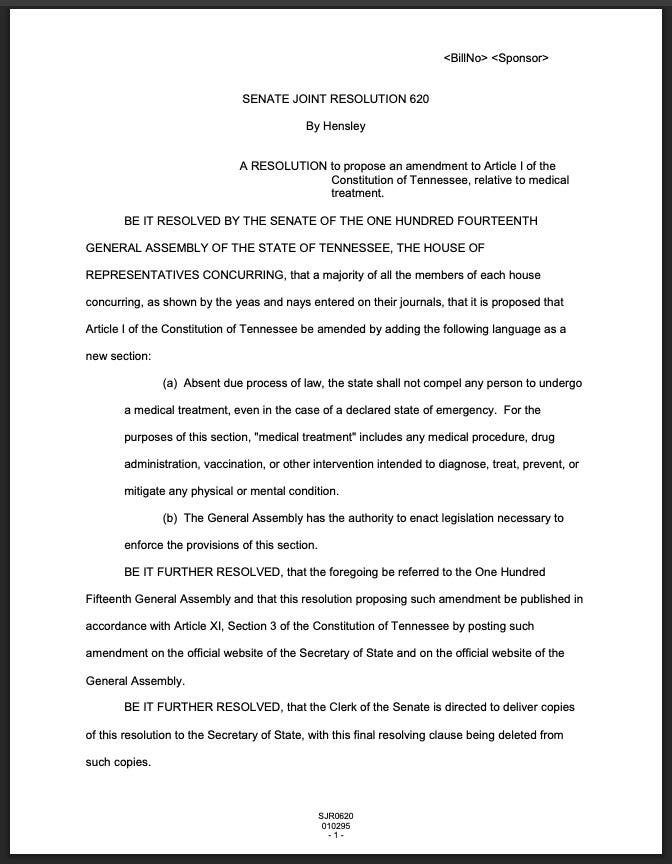
Senate Joint Resolution 620 (SJR0620), sponsored by Senator Joseph Hensley (R), a medical doctor, proposes adding a new section to Article I of the Tennessee Constitution establishing that:
“Absent due process of law, the state shall not compel any person to undergo a medical treatment, even in the case of a declared state of emergency.”
The resolution further defines “medical treatment” broadly to include:
“any medical procedure, drug administration, vaccination, or other intervention intended to diagnose, treat, prevent, or mitigate any physical or mental condition.”
Where the Bill Stands
SJR0620 was introduced January 22, 2026, and has since progressed through early Senate steps.
As of March 23, 2026, it has been:
- Passed on First Consideration
- Passed on Second Consideration
- Referred to the Senate Judiciary Committee
- Assigned to the General Subcommittee of Senate Judiciary, where it is currently pending
The resolution has not yet passed out of committee.
You can contact Tennessee Senate members here to voice support for the bill (see the bill’s limitations below).
What the Bill Must Undergo to Become Law
Because this is a constitutional amendment, the threshold is significantly higher than a standard bill.
For SJR0620 to take effect, it must:
- Pass both chambers of the Tennessee General Assembly
- Be passed again by the next General Assembly (2027–2028 session)
- Be placed on a statewide ballot
- Receive majority approval from Tennessee voters
Until all four steps occur, the proposal has no legal force.

What the Amendment Would Do
If adopted, the amendment would establish a constitutional barrier against blanket medical mandates.
It would:
- Block the state from forcing medical interventions without legal process
- Apply that protection even during declared emergencies
- Cover all forms of treatment, including vaccines, pharmaceuticals, and procedures
The language directly addresses the type of authority used during COVID-era emergency responses, where governments asserted broad power to require medical interventions under emergency declarations.
Health Freedom Principles Being Advanced
The resolution reinforces several core principles:
- Bodily autonomy: individuals cannot be forced into medical interventions by default
- Informed consent: medical decisions remain with the individual absent legal adjudication
- Limits on emergency power: emergency declarations alone cannot override personal medical choice
- Constitutional protection: elevates these principles above statutory law, making them harder to bypass
By placing these protections in the state constitution, the measure seeks to lock in restrictions on government authority that would otherwise fluctuate with changing administrations or emergency declarations.
The Limitation: A Built-In Legal Pathway
The amendment includes a critical qualifier:
“Absent due process of law…”
This clause creates a clear limitation.
While the state cannot impose blanket mandates, it retains the ability to compel medical treatment through legal proceedings.
In practice, this means:
- Courts could authorize forced treatment under certain conditions
- The legislature could pass laws outlining how that process works
- Emergency powers are restricted—but not eliminated
The resolution itself explicitly affirms:
“The General Assembly has the authority to enact legislation necessary to enforce the provisions of this section.”
That enforcement authority opens the door for future laws defining when and how compelled treatment could still occur under judicial oversight.
Bottom Line
Tennessee lawmakers are advancing a constitutional amendment designed to prevent the state from forcing medical treatment, even during emergencies, marking a direct response to recent public health mandates.
The proposal strengthens protections for bodily autonomy and informed consent at the constitutional level.
But it stops short of a full prohibition, preserving a pathway for compelled treatment through courts and future legislation—ensuring the power is constrained, not removed.
Your support is crucial in helping us defeat mass censorship. Please consider donating via Locals or check out our unique merch. Follow us on X @ModernityNews.
More news on our radar