



This post was published by Jon Fleetwood. Support him by subscribing at Substack and following at Instagram / X / Facebook.

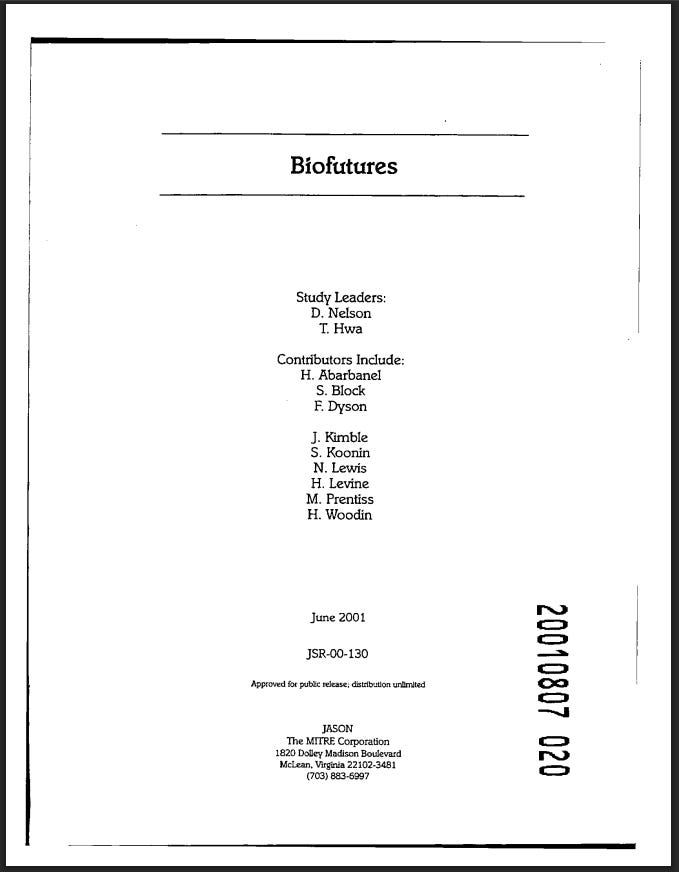
Nearly a decade before the U.S. military’s Defense Advanced Research Projects Agency (DARPA) launched PROPHECY to “predict” the digital genetic sequences of future viruses not known to exist, the agency funded a little-known study asking a far broader question, called Biofutures.
Not how to predict future viruses.
Not how to develop faster vaccines.
But how biology itself as a scientific discipline should change as computational modeling became increasingly powerful.
Published in June 2001 by the JASON advisory group, Biofutures never mentions pandemics, coronaviruses, or viral surveillance.
Instead, it proposes a computational philosophy that later appears repeatedly across DARPA’s pandemic biotech portfolio—including PROPHECY, ADEPT, the Pandemic Prevention Platform (P3), PREEMPT, and even the DARPA-funded DEFUSE proposal.
Viewed alongside those later programs, Biofutures provides important context for what I have previously described as the In Silico Theory of pandemic orchestration—a framework for examining how predictive algorithms, laboratory-generated sequence information, genomic reference architectures, surveillance systems, diagnostics, and pharmaceutical platforms could collectively define and operationalize a pandemic (whether the triggering event involved a naturally occurring pathogen, a laboratory-associated release, an intentionally deployed biological agent, or a predominantly informational system built around an accepted digital sequence).
A New Way of Doing Biology
The report begins by explaining exactly what its authors set out to study.
They write: “The goal of the 2000 JASON summer study on ‘Biofutures’ was to explore prospects for computer modeling of cellular biochemical networks and to ask more generally about the role of modeling in biology.”
Then comes perhaps the report’s most revealing statement.

Rather than assuming biology should continue relying primarily on traditional biological approaches, the authors suggest: “It is far from clear that reductionist models from the physical sciences are the right paradigm—methodologies taken from operations research or electrical engineering may be more relevant.”
The proposal is not simply to use more computers.
It is to reconsider how biology as a science should be conducted.
Building Biology Inside Computers
The report immediately describes the kind of future it envisions.
It states: “The genomes of over 36 organisms… could be used to construct computer (’in silico’) models of organisms.”
The purpose of those models extends far beyond visualization.
According to the report: “A successful effort of this kind would allow predictions of the response of simple organisms to drugs, changes in the environment or gene knockouts.”
The authors continue: “Such models could also be an aid to rational drug design and could perhaps even guide biological research.”
They add that increasingly detailed models: “could aid in the design of cells which sense harmful factors in the environment or allow switching from one type of behavior to another.”
The direction is clear.
First build the computational model.
Then use the model to generate biological predictions.
Then use those predictions to inform drug development and laboratory research.
Prediction Before Experimentation
One of the report’s central themes is that computation should increasingly come before laboratory experimentation.
The authors write: “One could imagine biological research laboratories using computer simulations to test for the most promising avenues of research before going to a wet lab.”
They continue: “The experiments would lead to changes in the model that would, in turn, lead to more experiments.”
Finally, they describe: “The possibility of a real ongoing dialog of this kind between theoretical modeling and experiments in the biological world is an exciting one.”
Rather than observation producing models, the report increasingly envisions models producing experiments.
Prediction comes first.
Laboratory work increasingly follows.
The Model Becomes the Experiment
DARPA’s Biofutures goes even further.
Rather than treating computers simply as tools for analyzing biological observations, the report proposes using computational models as experimental environments.
The authors write: “One can substitute the model for the system and carry out computational experiments that might be impossible (or more difficult/costly etc.) to perform on the wet ware itself.”
In other words, certain experiments could increasingly occur inside the model before being attempted in the laboratory.
Models Begin Directing Biology
The report also repeatedly argues that computational models should increasingly determine what scientists investigate.
The authors explain: “The existence of the model often forces a re-prioritization for experimental work and spurs efforts to measure those quantities that are needed to critically test and thereby improve the model.”
They continue: “Similarly, the existence of a model often spurs consistency in form and format of data reporting…”
before concluding: “A good model can spur such systemization.”
The direction of causality has changed.
The laboratory is no longer simply informing the model.
The model increasingly informs the laboratory.
The Same Philosophy Reappears
Nine years later, DARPA’s PROPHECY (here, here) program applied a remarkably similar workflow to viral evolution.
Rather than waiting for future viral populations to emerge before beginning countermeasure development, PROPHECY sought to: “predict mutations and possibly reassortments in advance of their occurrence”
through: “predictive algorithms”
that would be: “informed and validated experimentally using high throughput biological platforms.”
The program ultimately sought: “developing drugs and vaccines in advance of need.”
Although the application differs, the sequence is strikingly similar.
Model.
Predict.
Experimentally validate.
Refine.
The same computational-first philosophy appears elsewhere throughout DARPA’s biotechnology portfolio.
ADEPT pursued programmable gene-encoded countermeasures designed directly from genetic information.
P3 acknowledged that during future outbreaks: “only electronic viral sequence information may be available”
while still pursuing protective countermeasures.
PREEMPT later instructed performers that: “the output of TA1 in silico models will guide preventive method design.”
Across programs spanning nearly two decades, the underlying workflow repeatedly remains the same:
- models first;
- predictions second;
- laboratory validation third;
- implementation afterward.
Bottom Line
DARPA’s Biofutures is not a pandemic program.
It does not discuss coronaviruses, biodefense, wildlife surveillance, or vaccine deployment.
Instead, it proposes something arguably more fundamental.
The report repeatedly argues that biology should increasingly begin with computational models capable of generating predictions, directing experiments, informing drug design, standardizing biological information, and organizing scientific research itself.
Nearly a decade later, DARPA’s biotechnology programs begin applying that same computational philosophy to increasingly specific objectives.
PROPHECY sought to predict future viral evolution.
ADEPT translated genetic information into programmable countermeasures.
P3 prepared to operate when “only electronic viral sequence information may be available.”
PREEMPT instructed performers that “the output of TA1 in silico models will guide preventive method design.”
Whether viewed as the evolution of computational biology or as a recurring design philosophy within DARPA’s pandemic portfolio, the continuity is difficult to ignore.
Before DARPA’s pandemic-related programs focused on “predicting” future viruses that don’t exist, accelerating countermeasures, or guiding preventive designs, Biofutures had already proposed a broader transformation: that biology itself should increasingly begin inside the computer.
For this publication’s In Silico Theory, Biofutures is significant because it documents the underlying computational philosophy before it appears in later DARPA programs devoted to predicting pathogens, designing countermeasures, and guiding preventive strategies.
Your support is crucial in helping us defeat mass censorship. Please consider donating via Locals or check out our unique merch. Follow us on X @ModernityNews.
More news on our radar