



This post was published by Jon Fleetwood. Support him by subscribing at Substack and following at Instagram / X / Facebook.

A peer-reviewed study funded by the National Institutes of Health (NIH) and published in 2019 says researchers intentionally mutated hantavirus glycoproteins and used serial passage to create what the study itself called “highly infectious” recombinant viral systems.
The revelation comes amid an alleged hantavirus outbreak linked to the cruise ship MV Hondius, which departed Argentina in April 2026.
The resurfaced gain-of-function work was funded under a multi-million-dollar NIH/NIAID grant AI132633 at Albert Einstein College of Medicine.
NIH RePORTER records show the project began in 2017 and remained active during the 2018 experiments that produced the infectivity-enhancing mutations described in the paper.
The study, published in mBio, states researchers started with wild-type Hantaan virus (HTNV) glycoproteins that were said to produce only poor rescue and replication in a recombinant vesicular stomatitis virus (rVSV) system.
One of the paper’s lead authors, Dr. Kartik Chandran, now also serves as the project lead of NIAID’s active $70 million PROVIDENT hantavirus pandemic-preparedness program, which had just completed unprecedented Andes hantavirus mapping and vaccine-platform engineering before the 2026 outbreak emerged.
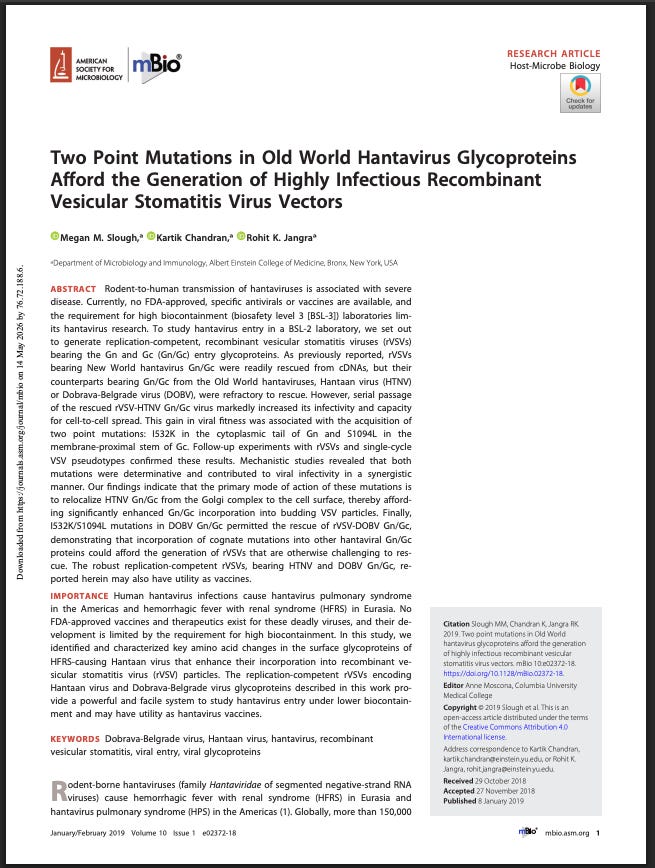
According to the paper: “Multiplication and spread of the early passage rVSV bearing HTNV Gn/Gc were poor but improved dramatically following three serial passages in Vero cells.”
The paper states the serial passage experiments produced two mutations:
- I532K in Gn
- S1094L in Gc
According to the study: “This gain in viral fitness was associated with the acquisition of two point mutations.”
Researchers then intentionally rebuilt those mutations back into the recombinant viral constructs.
The paper states: “we attempted to rescue rVSV-HTNV Gn/Gc viruses from cDNAs, incorporating each mutation separately and together.”
The resulting double-mutant chimera pathogen displayed dramatically enhanced infectivity and spread.
According to the paper: c“The Gn/Gc double mutant virus (I532K/S1094L) multiplied and spread more rapidly than either single mutant virus.”
The paper further states: “pVSVs bearing the HTNV Gn/Gc (I532K/S1094L) double mutant displayed a higher specific (per-particle) infectivity.”
The title of the paper itself described the final construct as: “Highly Infectious Recombinant Vesicular Stomatitis Virus Vectors.”
The paper openly documented serial passage selection followed by deliberate mutagenesis that produced substantially more infectious recombinant hantavirus-related chimeras under an NIH/NIAID-funded project.

According to a 2022 review published in Advances in Applied Microbiology:
“Gain-of-Function research on viruses is enhancing transmissibility, virus replication, virulence, host range, immune evasion or drug and vaccine resistance to get insights into the viral mechanisms, to create and analyze animal models, to accelerate drug and vaccine development and to improve pandemic preparedness.”
The mBio study matches that definition because the researchers used serial passage and intentional glycoprotein mutations to create recombinant hantavirus-related chimeras with enhanced infectivity, replication efficiency, and cell-to-cell spread.
Bottom Line
The paper shows federally funded researchers have been intentionally selecting and engineering hantavirus glycoprotein mutations that transformed allegedly weak recombinant systems into what the study itself repeatedly described as “highly infectious” viral chimeras.
Your support is crucial in helping us defeat mass censorship. Please consider donating via Locals or check out our unique merch. Follow us on X @ModernityNews.
More news on our radar