



This post was published by Jon Fleetwood. Support him by subscribing at Substack and following at Instagram / X / Facebook.

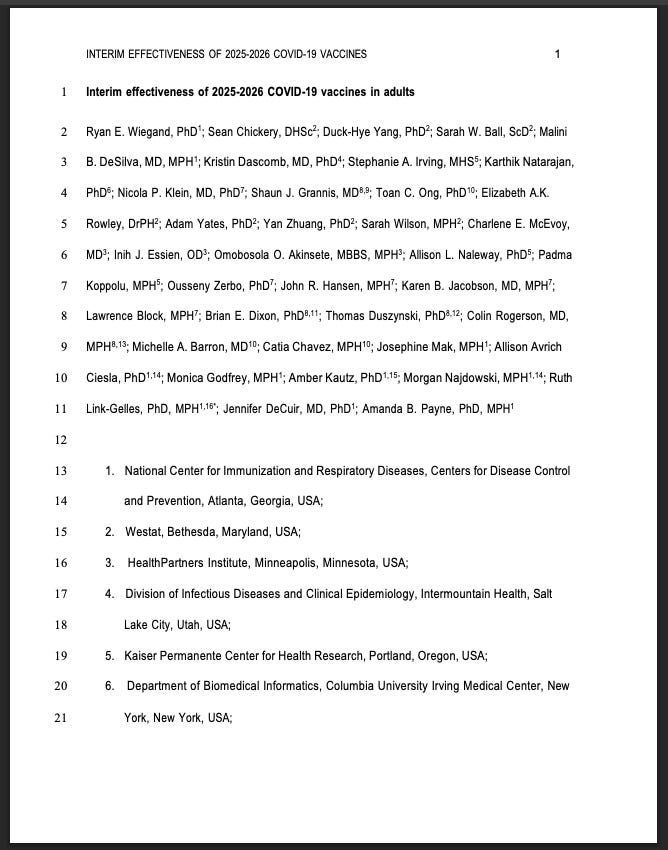
A leaked CDC-backed 2025–2026 COVID-19 vaccine effectiveness study is drawing serious scrutiny after revealing that its dozens of authors from the CDC, Westat, Kaiser Permanente, Columbia University, Indiana University, the University of Colorado, and other major institutions claimed the latest COVID shot provided substantial “additional protection” while failing to properly account for the most fundamental scientific variable of all: whether participants were already protected by prior COVID infections, previous vaccine doses, or both.
The claimed “benefit” was that the updated vaccine independently reduced serious COVID-related medical visits by roughly half.
But the study design makes that impossible to determine.
In plain English, this is like claiming a new bulletproof vest saved lives without knowing whether the people wearing it were already wearing armour beforehand.
Because the study failed to properly measure preexisting immunity, it is not possible to know whether the reported protection came from the 2025–2026 vaccine itself, prior infections, older vaccines, or hybrid immunity, making the paper’s central public-facing claim fundamentally confounded.
The manuscript was first made public by physician and Substack author Jeremy Faust, who published the study on Monday through Inside Medicine after reporting that CDC leadership blocked its publication in the agency’s Morbidity and Mortality Weekly Report (MMWR).
Headline Claims Push ‘Additional Protection’
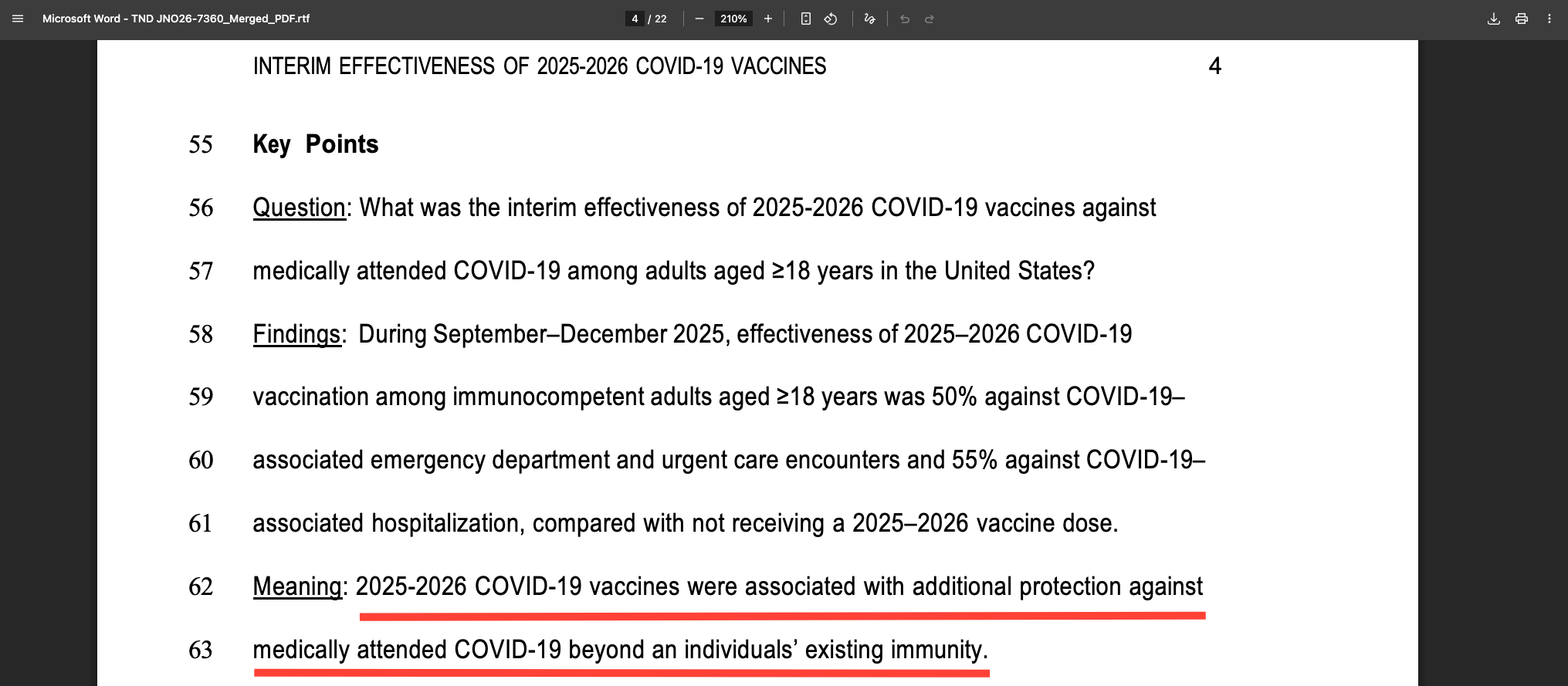
The leaked study’s Key Points section prominently states: “2025-2026 COVID-19 vaccines were associated with additional protection against medically attended COVID-19 beyond an individuals’ existing immunity.”
Researchers reported:
- 50% effectiveness against emergency department or urgent care visits
- 55% effectiveness against hospitalization
These figures were widely framed as evidence that the updated shots provided meaningful real-world benefit.
Buried Admission Undermines Central Claim

However, on page 13, the authors quietly acknowledge: “Analyses did not account for previous SARS-CoV-2 infection or COVID-19 vaccination…”
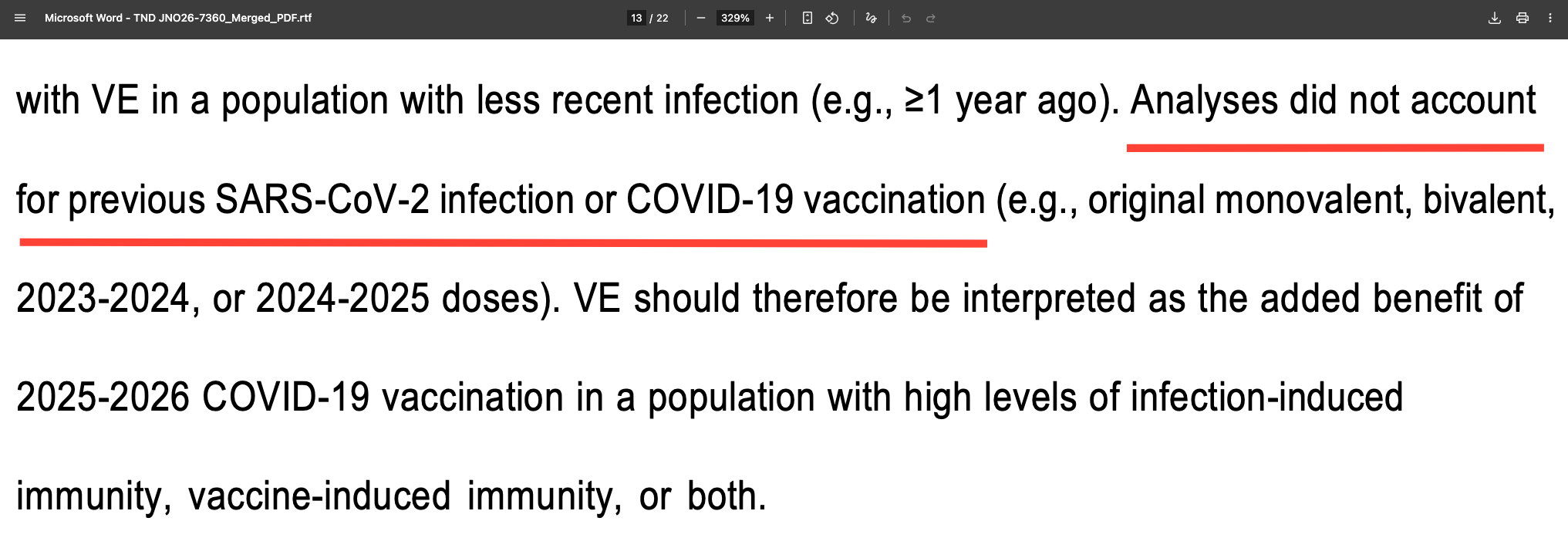
This means the study did not control for:
- Prior natural immunity from past COVID infections
- Previous monovalent shots
- Bivalent shots
- 2023–2024 boosters
- 2024–2025 boosters
Researchers compared people who got the latest shot against people who did not—without determining what preexisting immunity either group already possessed.
That means the study cannot tell whether the reported protection came from the new 2025–2026 shot itself, lingering immunity from prior infections or older vaccines, or some combination of all of them—making its headline “benefit” claim impossible to isolate with certainty.
The Paper’s Own Contradiction
Despite acknowledging this limitation, the authors still conclude: “Receipt of 2025-2026 COVID-19 vaccination provided additional protection…”
Yet without separating prior immunity variables, the claimed benefit cannot be cleanly attributed to the 2025–2026 vaccine itself.
Positive Messaging Front-Loaded, Caveats Buried
The structure of the paper places:
- Strong efficacy claims in the title, abstract, and key points
- Major confounding limitations deep in the discussion section
This creates a misleading public narrative where most readers, journalists, and policymakers are likely to see the positive headline figures without understanding the severe methodological caveats.
Authors & Institutional Affiliations Behind the Leaked Study
The manuscript was authored by a large network of federal officials, contractors, academic researchers, and major healthcare system investigators spanning the CDC, Westat, Kaiser Permanente, Columbia University, Indiana University, University of Colorado, and other major institutions:
- Ryan E. Wiegand, PhD — CDC National Center for Immunization and Respiratory Diseases
- Sean Chickery, DHSc — Westat, Bethesda, Maryland
- Duck-Hye Yang, PhD — Westat
- Sarah W. Ball, ScD — CDC
- Malini B. DeSilva, MD, MPH — CDC
- Kristin Dascomb, MD, PhD — Intermountain Health, Utah
- Stephanie A. Irving, MHS — Kaiser Permanente Center for Health Research, Oregon
- Karthik Natarajan, PhD — Columbia University Irving Medical Center
- Nicola P. Klein, MD, PhD — Kaiser Permanente Northern California Vaccine Study Center
- Shaun J. Grannis, MD — Regenstrief Institute / Indiana University
- Toan C. Ong, PhD — University of Colorado Anschutz Medical Campus
- Elizabeth A.K. Rowley, DrPH — Westat
- Adam Yates, PhD — Westat
- Yan Zhuang, PhD — Westat
- Sarah Wilson, MPH — Westat
- Charlene E. McEvoy, MD — HealthPartners Institute
- Inih J. Essien, OD — HealthPartners Institute
- Omobosola O. Akinsete, MBBS, MPH — HealthPartners Institute
- Allison L. Naleway, PhD — Kaiser Permanente Center for Health Research
- Padma Koppolu, MPH — Kaiser Permanente Center for Health Research
- Ousseny Zerbo, PhD — Kaiser Permanente Northern California
- John R. Hansen, MPH — Kaiser Permanente Northern California
- Karen B. Jacobson, MD, MPH — Kaiser Permanente Northern California
- Lawrence Block, MPH — Kaiser Permanente Northern California
- Brian E. Dixon, PhD — Regenstrief Institute / Indiana University
- Thomas Duszynski, PhD — Indiana University
- Colin Rogerson, MD, MPH — Indiana University
- Michelle A. Barron, MD — University of Colorado
- Catia Chavez, MPH — University of Colorado
- Josephine Mak, MPH — CDC
- Allison Avrich Ciesla, PhD — CDC / Eagle Health Analytics
- Monica Godfrey, MPH — CDC
- Amber Kautz, PhD — CDC / General Dynamics Information Technology
- Morgan Najdowski, MPH — CDC / Eagle Health Analytics
- Ruth Link-Gelles, PhD, MPH — CDC / U.S. Public Health Service
- Jennifer DeCuir, MD, PhD — CDC
- Amanda B. Payne, PhD, MPH — CDC
Despite their combined scientific credentials, institutional prestige, and access to advanced epidemiological expertise, these researchers collectively attached their names to a study that publicly implied the 2025–2026 COVID shot independently provided substantial “additional protection,” while concealing in the page-13 fine print that they failed to control for prior infections and prior vaccination history—the very variables required to determine whether the new shot itself provided any measurable independent benefit at all.
For many observers, this is not a minor oversight.
It represents a profound scientific and ethical failure.
Dozens of federally connected scientists, academic researchers, and major healthcare officials used the authority of their institutions to advance a headline conclusion that could easily mislead policymakers, physicians, journalists, and the public.
All while burying methodological omissions so severe that the study’s central effectiveness claim becomes fundamentally incapable of isolating the true source of the reported protection.
Dr. Richard Bartlett, a thirty-year emergency room director, called the omission “mind-blowing.”
He told this website:
“It’s mind-blowing that all of the so-called ‘experts’ who authored this paper refused to include prior infection and prior vaccination status in their analysis. Those are among the most fundamental variables necessary to determine where immunity is actually coming from. When researchers omit factors this critical, it feels purposeful and deceptive. The American people deserve transparent, scientifically rigorous research—not headline claims built on methodology that cannot clearly determine what is actually providing the protection.”
Bottom Line
The leaked CDC-backed 2025–2026 COVID vaccine paper used the authority of federal agencies, elite universities, healthcare systems, and dozens of credentialed researchers to promote headline claims that the latest shot delivered 50–55% “additional protection,” while burying the critical admission that prior infections and prior vaccination history were never properly accounted for.
Because the study failed to control for the very sources of immunity necessary to isolate the new shot’s independent effect, its central public-facing claim cannot reliably determine whether the reported protection came from the updated vaccine itself, prior natural immunity, older vaccine doses, or overlapping hybrid immunity.
For many critics, this is a profound scientific and ethical breach in which major public health institutions advanced conclusions that could significantly mislead the public, policymakers, and medical professionals while presenting deeply confounded observational data as meaningful evidence of vaccine-specific benefit.
Your support is crucial in helping us defeat mass censorship. Please consider donating via Locals or check out our unique merch. Follow us on X @ModernityNews.
More news on our radar