














This post, authored by Guy de la Bèdoyère, is republished with permission from The Daily Sceptic

Where is Diogenes the Cynic (404-325 BC) when you need him? We could certainly do with him now. Diogenes established such a reputation that anecdotes about him have circulated ever since his lifetime. He remains significant as a founder of the Cynic school of philosophy and a direct intellectual forerunner to the Stoics, influencing Western thought through his radical rejection of societal conventions and his emphasis on living a life of asceticism, self-sufficiency and virtue in accordance with nature.
He is a legendary figure known for his public acts and sharp wit, which aimed to expose human hypocrisy and awaken others to a more honest, rational way of life. None of his own writings survive. We are entirely dependent on other authors for stories about his life, most of all his namesake Diogenes Laertius who wrote a series of lives of the ‘eminent philosophers’ in the third century AD.
Long ago I read a slim Pelican paperback called Aspects of Antiquity (1972), a collection of essays by a classicist called Moses Finley. I enjoyed reading all of them but especially the one called ‘Diogenes the Cynic’. Finley invited the reader to ask whether Diogenes was a crackpot or a saint, or both. In antiquity he was seen as a necessary foil to hubris and conceit, especially of rulers and leaders.
No wonder then that some of the most famous stories about Diogenes concerned his encounters with Alexander the Great. Whether they are or true or not hardly seems to matter now any more than when they circulated in antiquity.
Diogenes was born in Sinope, a city in the middle of the northern coast of Anatolia overlooking the Black Sea. Diogenes dedicated himself to learning and frugality. He was also interested in self-discipline and hard practice as a driving force behind one’s life. Diogenes was supposedly inspired by watching a mouse darting around in the dark, neither afraid nor interested in the sort of luxuries people are obsessed by. He also believed that choosing to be happy meant spurning the misery of futile hard work. Diogenes took this further by believing that self-discipline freed one from obsessively seeking pleasure, and that instead one could derive pleasure from despising pleasure.
Alexander the Great was allegedly impressed by Diogenes when he met the great man, by then very elderly, in Corinth. Diogenes was less enthralled by Alexander. The Greeks had assembled at the Isthmus of Corinth where they elected Alexander to lead a force against the Persians. Alexander had hoped to meet Diogenes there, but the philosopher had no interest in him. Alexander therefore had to seek Diogenes out. He found Diogenes enjoying lying in the sun. Alexander asked Diogenes if there was anything he could do for him. Diogenes languidly asked him to move over a little and thereby get out of the way of the sunshine. Alexander’s flunkies enjoyed this and laughed at him.
A third story about Diogenes and Alexander claims that Alexander asked him, “Are you not afraid of me?” Instead of answering, Diogenes asked Alexander if he was a good or bad thing. Alexander of course said he was a good thing, to which Diogenes replied with “Who then is afraid of the good?”
The use of Alexander, the most significant and glamorous presence in the Western ancient world at the time, was important because he added value to the Diogenes stories. The relevance and significance of Diogenes’s sayings were greatly enhanced by association.
Alexander, despite being in many ways a preening narcissist, was far from being insulted. Instead, he was fascinated by Diogenes’s lack of respect for his status and reputation. After the meeting, he said, “If I were not Alexander, I would choose to be Diogenes.”
As the Roman statesman Cicero said well over two centuries later, the incident was a brilliant exposition of the freedom a cynic philosopher could enjoy, liberated from the constraints of deference and ambition. Deference and ambition on the part of their followers and acolytes are of course the reasons why so many defective rulers manage to stay in power beyond their time.
Diogenes had claimed that he was better off than the king of Persia who could never have enough of what he wanted, whereas he, Diogenes, wanted nothing and therefore had a far better quality of life since he was completely satisfied.
A related story was that Alexander came upon Diogenes rummaging through rubbish and asked him what he was looking for. Diogenes tartly responded with how he was hunting for the bones of Alexander’s father, Philip II of Macedon, but was unable to distinguish them from the bones of slaves. Diogenes thought any claims to high birth and all the distinctions of high status to be nothing other than the symbols of vice.
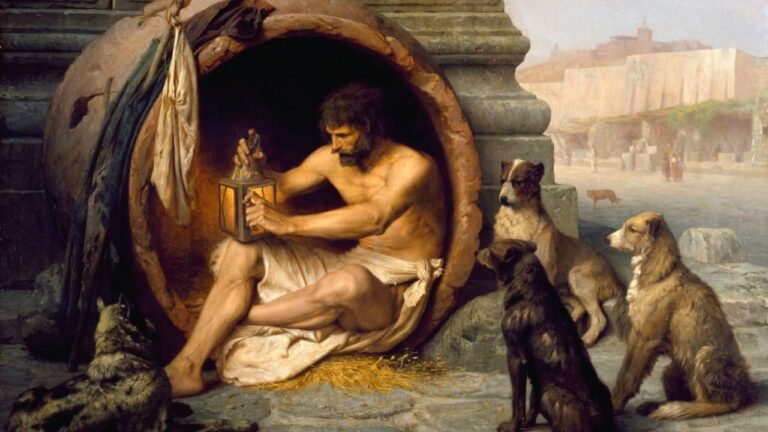
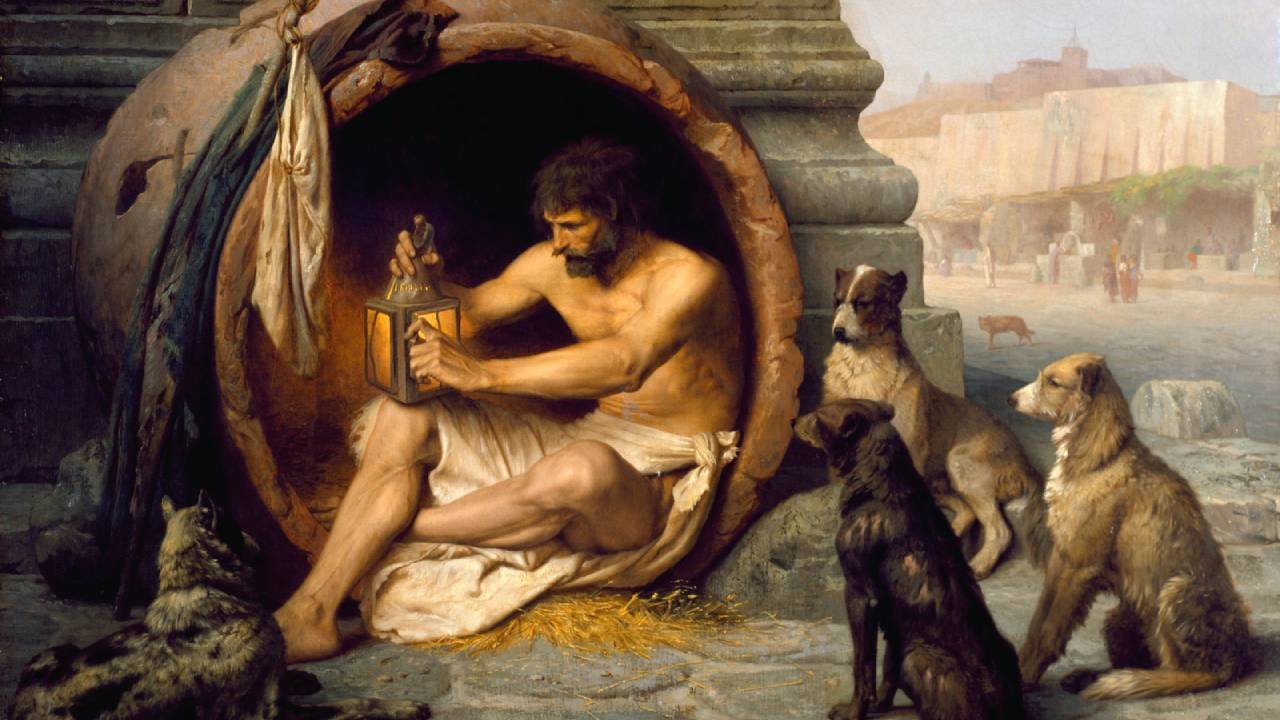
One of Diogenes’s habits was to wander round in full daylight carrying a lighted lamp, claiming to be looking for an honest man. Obviously, what he meant was that such individuals are so rare that artificial light is necessary, even during the daytime, to find one. He took this cynicism about men to greater heights. He once went to Olympia and on his return was asked if he had seen a great crowd of men. “A great crowd, yes,” he said, “a great crowd of men, no.”
Diogenes had an acerbic take on how human beings respond to crises. One cannot help but recall the panic buying of toilet paper from the shelves of supermarkets when COVID-19 broke in 2020. Diogenes, who lived some of his time in a barrel, was struck by the frantic activity when the Corinthians were confronted by war. In the commotion some were gathering food, others preparing defences or weapons, and some simply dashing about doing anything that made them feel better. Diogenes climbed out of his barrel and rolled it up and down the street. When asked why he was doing this, he said “I’m being busy like everyone else”.
Diogenes felt ambivalent about mankind, believing that while on one hand philosophers and physicians made humans the most intelligent living beings on earth, the sight of dream interpreters and the like, and those who followed them, made them stupider than any animal.
Diogenes was reputedly around 90 when he expired. There are at least three versions of how he died, which just goes to show unreliable ancient history can sometimes be. In Diogenes’s case, his personal reputation was such that ascribing any story to him added authenticity and made it more likely to be believed and more widely circulated. This in turn of course added to his reputation, reinforcing the cycle, and is best described as prestige attribution, a process by which an action, comment or saying is given false authority by associating it with someone like Alexander whose reputation enhances its credibility and significance. Diogenes was not the only one. To his annoyance, Cicero later discovered that certain jokes were being attributed to him that he knew he had never cracked.
The whole truth about Diogenes was therefore lost along the way, but this does not really matter very much. The lesson is that we need people like Diogenes on which to pin such sayings and thereby remind ourselves not to be beguiled by our leaders or ourselves. Diogenes became both a historical phenomenon and a man of the present who might have walked the streets of London or Washington, or any other great city, and said the same things now about our leaders and the madness and delusions of ordinary people that he once supposedly said in the fourth century BC.
Whether the Alexander stories were true or not is far less important than the points being made about the vanity of power and its dependence on craven followers scuttling about in awe.
We live in extraordinary times but once begun these times must come to their end and give way to another era. And it is that era that will look back and shake its head and wonder about the insanities of the early 21st century.
Human beings have an extraordinary ability to indulge the fancy that their leaders are supermen and thereby to believe they are above all others and in possession of exceptional, even semi-divine qualities that set them apart from everyone else. This leads to the flattery of their conceits and follies and remorselessly to disappointment.
Worst of all, this also leads to disaster when such leaders, flushed with success and confidence seek to live up to the expectations bestowed on them by their hopeful and adoring followers. The emptiness of their pretensions is exposed when they turn out to be both imperfect and mortal.
Alexander’s personality and glamour were essential ingredients of his charisma, but it took Diogenes, or at least the sayings attributed to him, to cut him down to size. After Alexander died suddenly aged only about 32 in 323 BC the world was reminded how ephemeral power is.
When he was asked what the most beautiful thing in the world was, Diogenes answered “freedom of speech” (in Greek parresia, ‘freespokenness/frankness’).
We could do with someone like Diogenes today, could we not? And what would he say about us and our times?
Guy de la Bèdoyère is a historian and writer with many books to his credit, mostly about ancient Egypt and the Roman Empire. However, his latest book is The Confessions of Samuel Pepys. His Private Revelations (Abacus 2025, and in the US Pegasus 2026).
Your support is crucial in helping us defeat mass censorship. Please consider donating via Locals or check out our unique merch. Follow us on X @ModernityNews.
More news on our radar
