



This post was published by Jon Fleetwood. Support him by subscribing at Substack and following at Instagram / X / Facebook.

Scientists affiliated with the Wuhan Institute of Virology—the Chinese laboratory that came under international scrutiny during investigations into COVID-19 origins—have published a study describing experiments in which irradiated mosquitoes were said to be infected with engineered viruses, which were used to inject those viruses into bats through their bites.
The research, published last week in the journal Science Advances, describes a system in which mosquitoes are first X-ray sterilized, then infected with engineered viral vaccine constructs.
Once infected, the mosquitoes were said to carry the virus in their salivary glands and inject it into animals during feeding.
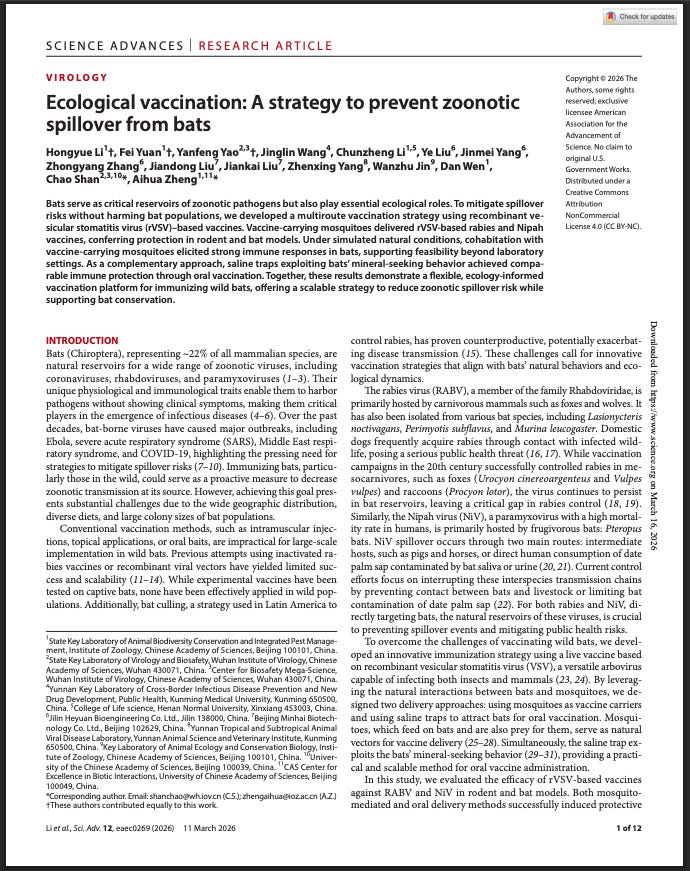
The paper describes the system as mosquito-mediated delivery of recombinant viral vaccines to bats.
The experiment represents an unprecedented development in biotechnology whereby insects are turned into autonomous delivery platforms capable of injecting engineered viruses into living populations.
The result is a system in which insects function as self-propelled delivery platforms for engineered viruses in the environment, raising significant implications for biosafety, national security, and international biosecurity.
The research was supported by Chinese government science programs, including the National Natural Science Foundation of China and the National Key Plan for Scientific Research and Development of China.
Sterilized Mosquitoes Infected With Engineered Viruses
In the experiments, female mosquitoes were first exposed to 40 gray (Gy) of radiation, a dose used to sterilize the insects so they cannot reproduce.
After irradiation, the mosquitoes were fed blood containing recombinant vesicular stomatitis virus (rVSV) vaccine constructs engineered to express proteins from viruses, including rabies virus and Nipah virus.
The study says the virus then replicated inside the mosquito and accumulated in its salivary glands.
When the mosquito later bit a bat, the engineered virus was delivered into the animal through the bite.
Each feeding event effectively functioned as a biological injection of the engineered viral construct.
Nipah Virus Component
Some of the constructs examined in the research target Nipah virus, a pathogen associated with fatality rates ranging from roughly 40% to 75% in human outbreaks.
Experiments evaluating immune responses to Nipah antigens were conducted under biosafety level-4 (BSL-4) containment, the highest level of pathogen security.
Proposed Release Into Bat Habitats
The paper also outlines possible deployment strategies beyond the laboratory.
These include:
- Releasing irradiated mosquitoes carrying engineered viral constructs into bat habitats
- Deploying vaccine bait traps near caves or tree roosts
The authors further state that future research could involve genetically modifying mosquitoes to increase the amount of viral material present in their saliva.
Biosecurity & Environmental Concerns
The experiments illustrate a biotechnology approach in which insects themselves become carriers capable of injecting engineered viruses into animals through biting.
Unlike conventional vaccination methods, which involve controlled injections, this system relies on free-moving insects capable of flying, feeding repeatedly, and interacting with multiple species.
Mosquitoes are already among the most effective disease vectors in the world, responsible for spreading pathogens such as malaria, dengue, Zika, and West Nile virus.
Using those same insects as delivery platforms for engineered viruses raises obvious questions about environmental containment, unintended exposure, and the potential for accidental or uncontrolled spread.
Those concerns carry additional weight given that the research involves scientists affiliated with the Wuhan Institute of Virology, a facility that has remained at the center of global debate over laboratory biosafety following the COVID-19 pandemic.
Your support is crucial in helping us defeat mass censorship. Please consider donating via Locals or check out our unique merch. Follow us on X @ModernityNews.
More news on our radar
