



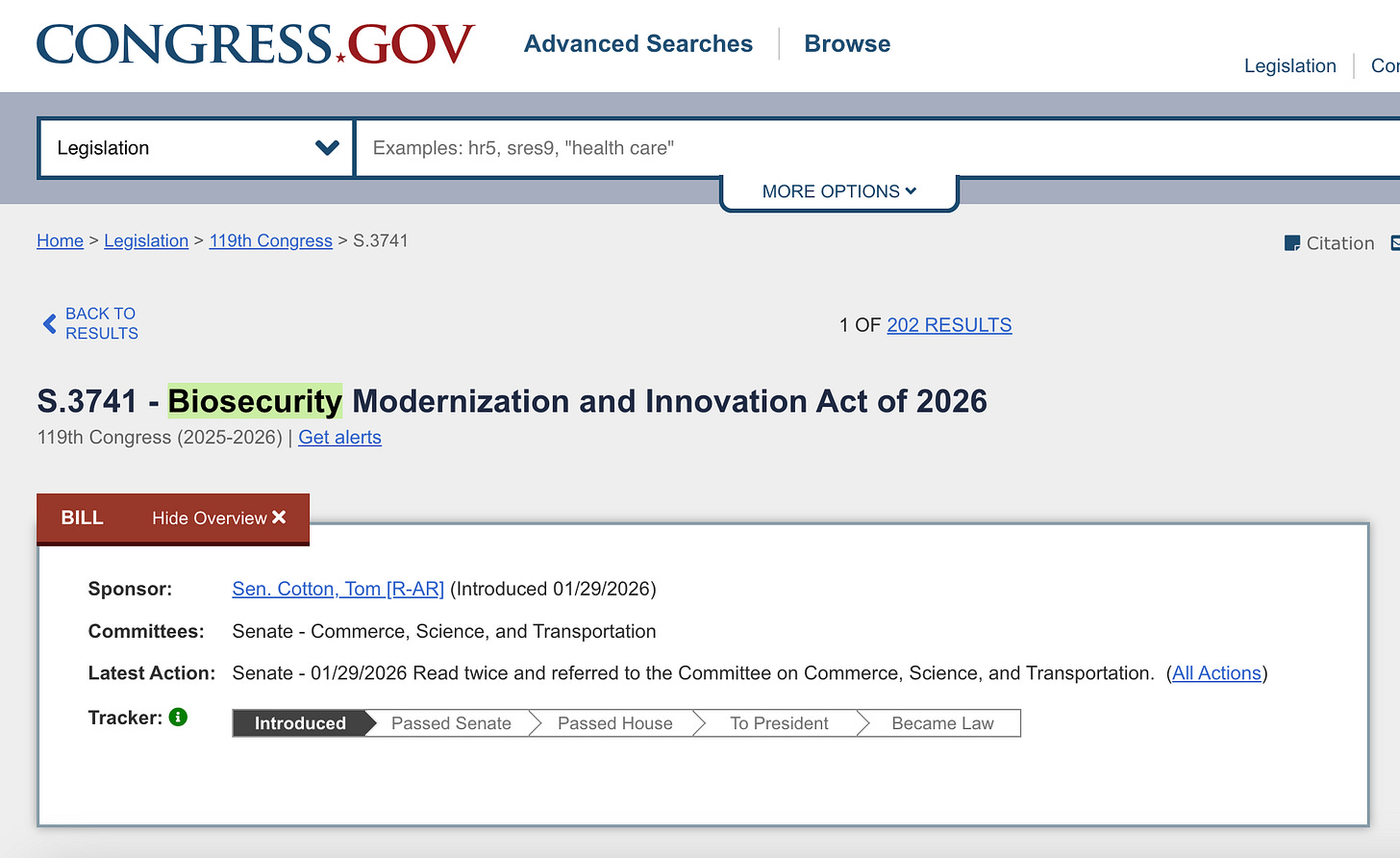
Congress has introduced legislation that would establish the first mandatory federal system to control and regulate the synthesis of DNA sequences said to be capable of creating pandemic-potential pathogens, replacing a longstanding voluntary system and placing federal authority at the genetic construction stage where pandemic pathogens originate.
The bill, S.3741, titled the “Biosecurity Modernization and Innovation Act of 2026,” was introduced January 29, 2026, by Sen. Tom Cotton (R-AR) and referred to the Senate Committee on Commerce, Science, and Transportation.
The legislation requires companies that manufacture synthetic DNA to screen customer orders and submit sequence information through a federally mandated system designed to identify and regulate access to genetic material capable of creating pandemic pathogens.
Because synthetic DNA is the starting point from which pandemic pathogens are built, the bill establishes federal control over the genetic origin stage itself—meaning that in the event of a bird flu pandemic, the federal government would hold regulatory authority over the very genetic sequences required to construct the virus and produce the countermeasures used to respond to it.
According to the bill: “The Secretary shall… establish… a requirement for covered providers to implement screening protocols for all sequences of concern.”
Lawmakers justify granting these authorities by presenting them as “mitigation” measures, stating the protocols must: “prioritize the mitigation of misuse of sequences capable of creating pathogens with pandemic potential.”
Synthetic DNA regulated under the bill is the foundational material used to construct purported viral genomes in laboratories and to develop the vaccines and countermeasures deployed during pandemic response operations.
Because pandemic pathogens cannot be physically constructed without first synthesizing their genetic sequences, regulating DNA synthesis places federal control at the starting point of both the pandemic threat and the government countermeasure pipeline.
For more than a decade, gene synthesis screening in the United States has operated primarily under voluntary federal guidance.
S.3741 replaces that voluntary system with mandatory federal regulation backed by financial penalties.
The bill explicitly states: “The regulations established… shall supplant any Federal guidelines or recommendations… that… are voluntary.”
Violations carry penalties of up to: “$500,000” for individuals and “$750,000” for organizations.
This converts what was previously an industry-managed process into a federally enforced regulatory system governing access to genetic material capable of creating pandemic pathogens.
Unlike emergency authorities activated during declared pandemics, this system operates continuously, placing permanent federal control over pandemic-capable genetic material regardless of whether a pandemic has been declared.
The legislation authorizes federal officials to create and expand a government-controlled list of genetic sequences subject to regulation.
The bill states: “A list of sequences of concern… shall be determined by the Secretary in consultation with… Federal departments and agencies, industry experts, academics, and researchers.”
The government can rapidly expand the list: “includes an expedited procedure to rapidly add sequences of concern to the list on a provisional basis.”
Because pandemic pathogens are said to be built from these genetic sequences, this authority allows the federal government to determine which pandemic-capable genetic material can be synthesized and under what conditions.
This authority applies at the precise stage where pandemic pathogens can first be created.
The legislation requires DNA synthesis companies to verify the identity of individuals and institutions attempting to obtain regulated sequences.
The bill states: “A requirement for covered providers to implement screening protocols to verify the identity and legitimacy of customers.”
This creates a federal system linking access to pandemic-capable genetic material to government-approved customers.
The legislation applies to what it defines as “covered providers,” which includes companies that manufacture synthetic DNA and those that sell DNA synthesis equipment.
The bill states: “The term ‘covered provider’ means a person who—
(A) synthesizes and sells synthetic nucleic acids to persons in the United States; or
(B) produces and distributes or sells, including resellers, equipment for synthesizing nucleic acids, including benchtop synthesizers, to persons in the United States.”
These companies are said to produce the genetic material used in virus construction and pandemic countermeasure development.
By subjecting them to mandatory federal screening, identity verification, and compliance requirements, the bill extends federal regulatory control directly into privately operated biotechnology companies involved in genetic production.
The legislation shields certain information collected under the federal DNA control system from public access.
The bill states: “Any information about a customer included in a submission… shall… be exempt from records access under section 552(b)(4) of title 5.
This protects customer identities and genetic sequence order information submitted into the federal system from public disclosure, raising transparency and oversight concerns.
The bill also creates a federal program to develop and test future biotechnology control systems.
It directs the government to: “establish a biotechnology governance sandbox environment.”
This program will be used to: “analyze emerging threats… and govern proactively in the biotechnology space.”
This creates federal infrastructure designed to expand government control over biotechnology tied to pandemic pathogens.
The legislation directs federal officials to evaluate whether additional authority and new government structures are needed.
The bill requires assessment of: “what, if any, new biosecurity and biosafety authorities are needed” and whether this would require: “establishing a new government entity.”
This lays the groundwork for expanding federal power over pandemic-related biotechnology systems.
Pandemics are said to originate from pathogens constructed from genetic sequences.
By replacing voluntary screening with mandatory federal regulation, controlling which pandemic-capable sequences can be synthesized, requiring identity verification, and extending federal authority into private DNA synthesis companies, S.3741 places federal power at the origin point where pandemic pathogens can be created.
This establishes federal control over the starting point of the pandemic pipeline itself —the genetic construction phase—placing government authority upstream of pathogen creation, countermeasure development, and the pandemic response systems that follow.
Your support is crucial in helping us defeat mass censorship. Please consider donating via Locals or check out our unique merch. Follow us on X @ModernityNews.
More news on our radar

How does any of this protect us from another Anthony Fauci gain of function pathogen?
Oh, GREAT. Using one of their Article 1 Section 8 Powers of Congress authorizations, congress will put another bureaucrat in charge of the future of mankind. Boy…do I feel better or what?
Why is synthetic DNA even legal?