



This post was published by Jon Fleetwood. Please visit his Substack and subscribe to support his work. Follow Jon: Instagram@realjonfleetwood / X@JonMFleetwood / Facebook@realjonfleetwood
The U.S. military and Health and Human Services (HHS) have funded an experiment that infected 36 individuals with an epidemic influenza A/Wisconsin/67/2005 (H3N2) virus that was manufactured in a laboratory, according to a June study published in the peer-reviewed journal Influenza and Other Respiratory Viruses.
Congress, the White House, the Department of Energy, the FBI, and the CIA have confirmed that the COVID-19 pandemic was likely the result of lab-engineered pathogen manipulation.
But the government is not only engineering outbreak pathogens in the lab—they’re intentionally infecting people with them.
The influenza strain A/Wisconsin/67/2005 (H3N2) used in the new study is associated with several influenza epidemics, notably during the 2005-2006 and 2006-2007 seasons, reportedly causing widespread outbreaks.
The DARPA-funded experiment’s implications reach far beyond academic inquiry, raising grave national security concerns because lab-engineered viruses have the potential to ignite epidemics and pandemics if accidentally or deliberately released.
It also raises serious informed-consent questions, since participants who became contagious could have exposed others outside the study to a laboratory-created pathogen without their knowledge.

The Funding Network
The research was financed by a network of U.S. government and private entities:
- the Centers for Disease Control and Prevention (CDC);
- the U.S. Department of Defense’s Defense Advanced Research Projects Agency (DARPA) Biological Technologies Office (BTO), under Col. Matthew Hepburn;
- the Office of the Assistant Secretary for Preparedness and Response, Biomedical Advanced Research and Development Authority (BARDA);
- and the National Institute of Allergy and Infectious Diseases (NIAID) through its Centers of Excellence for Influenza Research and Surveillance (CEIRS) program.
Additional financial support came from two private philanthropic organizations—the Flu Lab and the Balvi Philanthropic Fund, the latter founded by Ethereum co-creator Vitalik Buterin.
Who Conducted the Experiment
The study’s authors include:
- Jianyu Lai, Filbert Hong, Tianzhou Ma, and Donald K. Milton from the Department of Global, Environmental, and Occupational Health at the University of Maryland School of Public Health;
- P. Jacob Bueno de Mesquita from the Department of Public Health at Roger Williams University in Rhode Island;
- and Benjamin J. Cowling from the World Health Organization Collaborating Center for Infectious Disease Epidemiology and Control at the University of Hong Kong.
Both Milton and Cowling disclose financial relationships with vaccine manufacturers.
Cowling consults for AstraZeneca, Fosun Pharma, GlaxoSmithKline, Haleon, Moderna, Novavax, Pfizer, Roche, and Sanofi Pasteur.
Milton consults for A.I.R. LLC and holds stock options in Lumen Bioscience Inc.
Where the Infections Took Place
The infections were carried out as part of the “Evaluating Modes of Influenza Transmission (EMIT-1)” experimental study.
The paper confirms that the EMIT-1 trial was conducted under the authority of the United Kingdom Health Research Authority National Research Ethics Service Committee London–City & East, reference number 12/LO/1277, and registered on ClinicalTrials.gov as NCT01710111.
That trial ran from approximately October 2013 through June 2014.
The decade-long delay between the 2014 infections and the 2025 publication raises urgent questions about whether the data from this DARPA-funded human challenge were withheld as part of ongoing influenza pandemic preparation efforts—and whether it signals that authorities are quietly gearing up for another engineered flu pandemic.
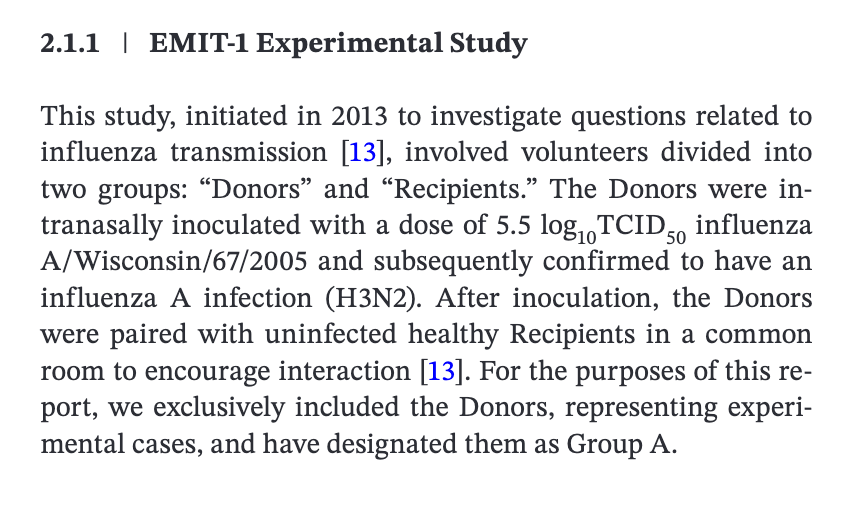
During the experiment, 36 human volunteers—identified as “Donors”—were deliberately inoculated intranasally with a laboratory-grown influenza A/Wisconsin/67/2005 (H3N2) virus at a concentration of 5.5 log?? TCID??, a tissue-culture infectious-dose measure used for controlled viral challenge studies.
The same virus stock was developed specifically for human challenge research.
After inoculation, the infected “Donors” were intentionally placed in shared rooms with uninfected “Recipients” to encourage close contact, allowing researchers to observe potential person-to-person transmission.
“The Donors were intranasally inoculated with a dose of 5.5 log10 TCID50 influenza A/Wisconsin/67/2005 and subsequently confirmed to have an influenza A infection (H3N2). After inoculation, the Donors were paired with uninfected healthy Recipients in a common room to encourage interaction,” the study reads.
Viral Shedding: At Least 11 Became Contagious
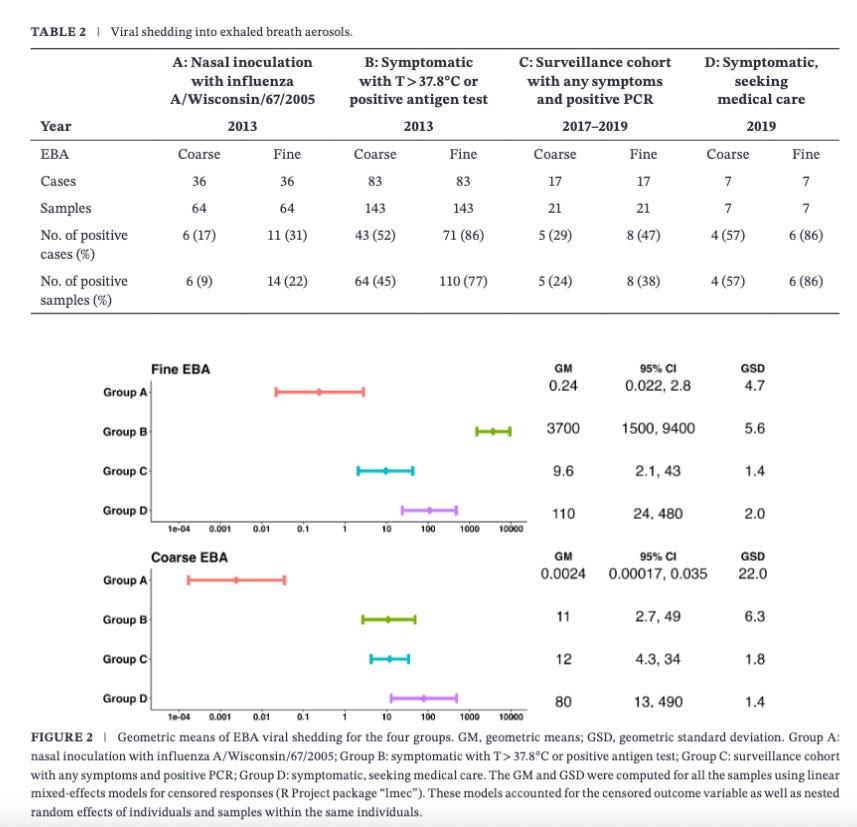
The most revealing—and alarming—aspect of the study involves what the authors call “exhaled breath aerosols,” or EBA.
The DARPA-funded researchers collected 30-minute samples of air exhaled by each participant using a specialized device that separates fine aerosols (particles ? 5 micrometers) from coarse aerosols (> 5 micrometers).
Even though these individuals were infected under apparently controlled conditions, nearly one-third released measurable quantities of the laboratory-engineered influenza virus into the air around them.
Specifically, 11 out of 36 infected subjects (31%) tested positive for fine-aerosol viral RNA, and 6 out of 36 (17%) were positive for coarse aerosols.
Each detection is said to demonstrate that airborne particles containing viral genetic material were expelled from the lungs or nasal passages—particles small enough to remain suspended and potentially be inhaled by others.
That means more than one in three of the intentionally infected volunteers were actively emitting laboratory-generated influenza virus into the air.
The study further notes that many of these individuals were either asymptomatic or only mildly ill at the time of sampling, proving that people infected in a laboratory can shed airborne virus even without obvious symptoms.
The authors also reported that these same individuals were “shedding substantial virus into nasopharyngeal swabs,” confirming viral replication and active release inside their airways.
The Authors’ Proposed Next Step
Perhaps most troubling, the paper concludes that intranasal inoculation “did not reproduce” the same level of aerosol shedding seen in naturally infected people and proposes that future models should use aerosol inoculation—that is, infecting subjects by having them inhale airborne virus—to more closely mimic natural transmission.
In the authors’ words:
“New models, including possibly aerosol inoculation, are needed to study viral aerosol shedding from the human respiratory tract.”
That recommendation implies a future escalation in human-challenge research—from deliberate nasal infection to deliberate aerosolized infection—bringing the experiments even closer to simulating real airborne contagion events.
Bottom Line
The study confirms that the U.S. Department of Defense’s DARPA, together with the CDC, BARDA, NIAID, the Flu Lab, and the Balvi Fund, funded a human-infection experiment that deliberately exposed 36 people to a laboratory-manufactured epidemic influenza virus, resulting in at least 11 individuals becoming contagious through airborne viral shedding.
The research was led by University of Maryland investigators in partnership with U.K. challenge-trial facilities under the EMIT-1 project—conducted under British ethics oversight but financed and directed in part by U.S. biodefense agencies.
Even under containment, the experiment created living, contagious carriers of a lab-engineered virus, a finding that raises profound ethical, national security, and biosecurity questions about the direction of federally funded pathogen-research programs.
Your support is crucial in helping us defeat mass censorship. Please consider donating via Locals or check out our unique merch. Follow us on X @ModernityNews.
More news on our radar
