



This post was published by Jon Fleetwood. Please visit his Substack and subscribe to support his work. Follow Jon: Instagram@realjonfleetwood / X@JonMFleetwood / Facebook@realjonfleetwood
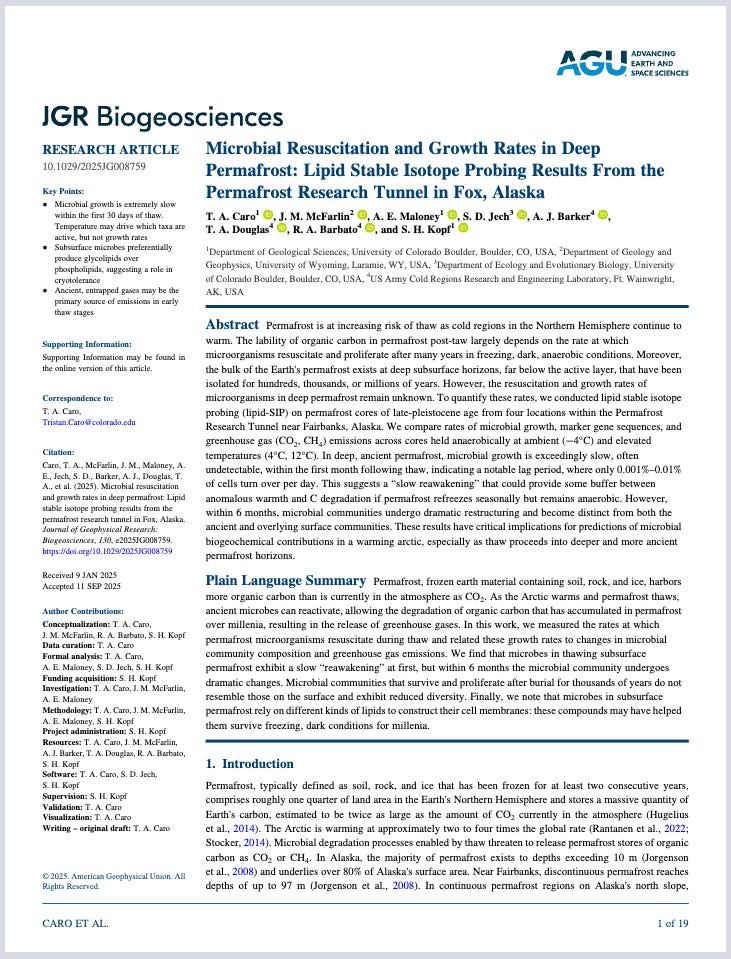
A peer-reviewed study published last month in JGR Biogeosciences (here) confirms that the U.S. Army has funded and participated in the revival of what the paper identifies as 40,000-year-old microorganisms from Arctic permafrost, including Clostridium species genetically related to Clostridium botulinum, the bacterium that produces botulinum toxin—one of the most lethal substances known to science.
The bacterial resurrection was conducted at the University of Colorado Boulder, raising questions as to whether the citizens of Boulder consent to having such high-risk military experiments conducted in their own backyard is a question that demands immediate public scrutiny.
The new study was published the same month President Donald Trump stood before the United Nations and called for an end to the creation of biological weapons.
That a U.S. Army–funded lab revived genetic relatives of one of the world’s deadliest bacteria in the very month a sitting president demanded an end to bioweapons research raises unavoidable questions about oversight, intent, and the boundaries between scientific inquiry and military experimentation.
Who Funded It & Where It Was Done
The study, titled “Microbial Resuscitation and Growth Rates in Deep Permafrost: Lipid Stable Isotope Probing Results from the Permafrost Research Tunnel in Fox, Alaska” (DOI: 10.1029/2025JG008759), was funded and co-conducted by the U.S. Army Cold Regions Research and Engineering Laboratory (CRREL) at Fort Wainwright, Alaska.
The work was done in collaboration with the University of Colorado Boulder, the University of Wyoming, and the Institute for Arctic and Alpine Research (INSTAAR).
The paper’s author list confirms the collaboration:
- T. A. Caro
- J. M. McFarlin
- A. E. Maloney
- S. D. Jech
- A. J. Barker
- T. A. Douglas
- R. A. Barbato
- and S. H. Kopf.
The experiments were conducted on permafrost samples extracted directly from the U.S. Army’s Permafrost Research Tunnel in Fox, Alaska, and later thawed and cultivated in laboratory incubators at the University of Colorado.
“Permafrost was collected from the U.S. Army Cold Regions Research and Engineering Laboratory Permafrost Tunnel located in Fox, Alaska, on 6 August 2021,” the study reads.
“All samples were transported to the Institute for Arctic and Alpine Research (INSTAAR) at the University of Colorado Boulder and stored at ?20°C until processing.”
What They Did
Scientists drilled what they characterize as late-Pleistocene permafrost cores—said to be up to 42,400 years old—and revived long-dormant microorganisms by thawing and feeding them heavy water isotopes to track biological activity:
“Subsurface permafrost samples are of late Pleistocene age (37.9—42.4 kya).”
“A subsection of core… was added to a 250 mL bottle along with 50 mL of filter-sterilized anaerobic ²H?O (1 at.% ²H) and the bottle was sealed with a butyl stopper.”
This process—lipid stable isotope probing (lipid-SIP)—was used to detect microbial growth, revealing that ancient bacterial spores had reawakened after what the paper characterizes as tens of thousands of years.
“We find that microbes in thawing subsurface permafrost exhibit a slow ‘reawakening’ at first, but within 6 months the microbial community undergoes dramatic changes.”
Clostridium Resurrected
Genetic sequencing identified one of the dominant revived bacterial groups as Clostridium sensu stricto 13—a genus that includes the deadly Clostridium botulinum.
“This permafrost starts with an extremely homogenous microbial community dominated by Clostridium sensu stricto 13, a genus housing a variety of spore-forming species including Clostridium bowmanii, Clostridium botulinum, and Clostridium huakuii.”
The researchers noted that these spore-forming organisms rapidly took over the thawed ecosystem:
“Dominant taxa in these samples such as Desulfosporosinus, Clostridium sensu stricto 13, and Psychrobacillus, are widely described as spore forming.”
Clostridium botulinum produces the botulinum neurotoxin—a CDC-classified Category A bioterror agent—capable of causing paralysis and death with minute doses.
The reactivation of its genetic relatives under military oversight raises serious biosecurity implications.
The COVID-19 pandemic was the result of lab-engineered pathogen manipulation, according to Congress, the White House, the Department of Energy, the FBI, and the CIA.
How Long They Were Frozen
Radiocarbon dating at the Woods Hole Oceanographic Institution was said to confirm the permafrost’s antiquity:
14C Age (kya)… 42.4 ± 3.4.
These microbial spores are said to have been sealed off since before the last Ice Age.
Findings
The study documents that resuscitated microorganisms began reproducing again within months:
“Microbial growth is exceedingly slow… however, within 6 months, microbial communities undergo dramatic restructuring and become distinct from both the ancient and overlying surface communities.”
The team observed a new post-revival ecosystem, describing it as:
“A ‘revenant’ microbial community that is clearly distinct from modern near-surface permafrost-hosted microbial communities.”JGR Biogeosciences – 2025 – Car…
In effect, the Army-backed experiment brought back an ancient microbial world—alive again in a laboratory environment.
Biosecurity Implications
The paper explicitly links revived taxa to spore-forming anaerobes—microbes with survival mechanisms identical to those that make C. botulinum so persistent.
The study acknowledges that thawed microbial populations underwent “dramatic restructuring” and that some dominant groups were Clostridium species.
The revival of these bacteria—particularly under U.S. military research infrastructure—raises dual-use concerns, where ostensibly environmental science may overlap with potential biological weapons–relevant research.
It also raises accidental and intentional lab leak concerns.
Bottom Line
A U.S. Army–funded team at the University of Colorado Boulder successfully revived bacteria said to be entombed for over 40,000 years, including Clostridium species genetically related to the producer of botulism toxin.
Under the stated goal of studying Arctic thaw, the project effectively achieved a laboratory resurrection of ancient, spore-forming microbes with potential pathogenicity.
With the U.S. military listed as both co-author and funder, the research signals a profound phase in biotechnology—where the world’s deadliest microbial ancestors are no longer extinct.
That the U.S. Army is helping fund laboratory resuscitation of what are said to be Ice-Age microbes underscores an urgent question for Congress and the scientific community alike: what safeguards exist to ensure that research framed as climate or ecological study does not inadvertently reintroduce, or even re-engineer, ancient biological threats?
Your support is crucial in helping us defeat mass censorship. Please consider donating via Locals or check out our unique merch. Follow us on X @ModernityNews.
More news on our radar

Till I first looked at the document which was of 8430 dollars, I accept that my friend’s brother was like really earning cash in his free time with his pc. T19 Her aunt’s neighbor has been doing this for 10 months and by now repaid the loan on their house and purchased a new Car .
Get started today… The site is mentioned on my profile name for everyone who is interested.”
I believe this ‘ancient microbes’ research programme is all tied in with the UN’s 2030 Agenda of global population reduction, with yet another additional method to help effect that agenda.
No doubt, Bill Gates will be loving this.
Just one question- WHY???